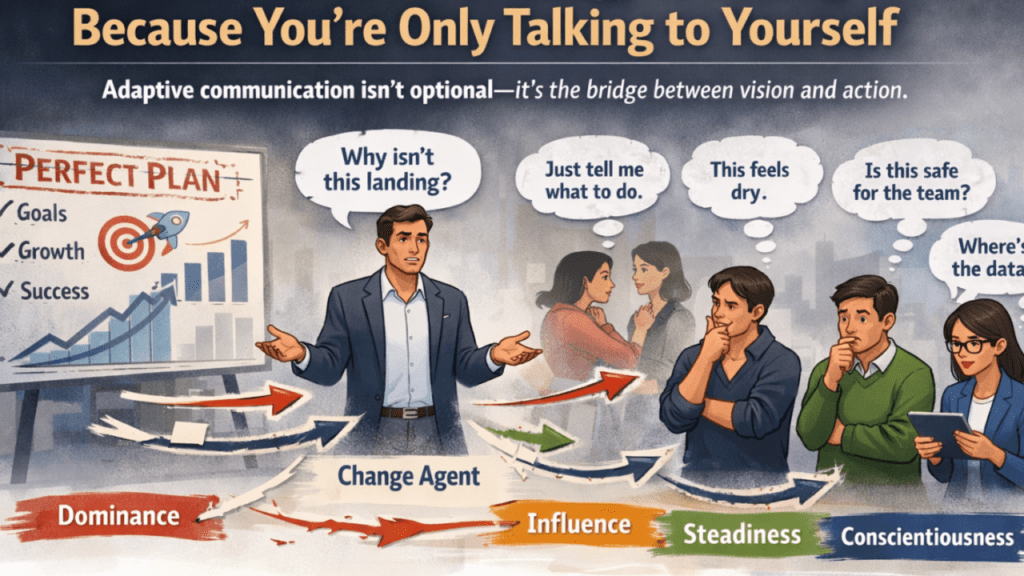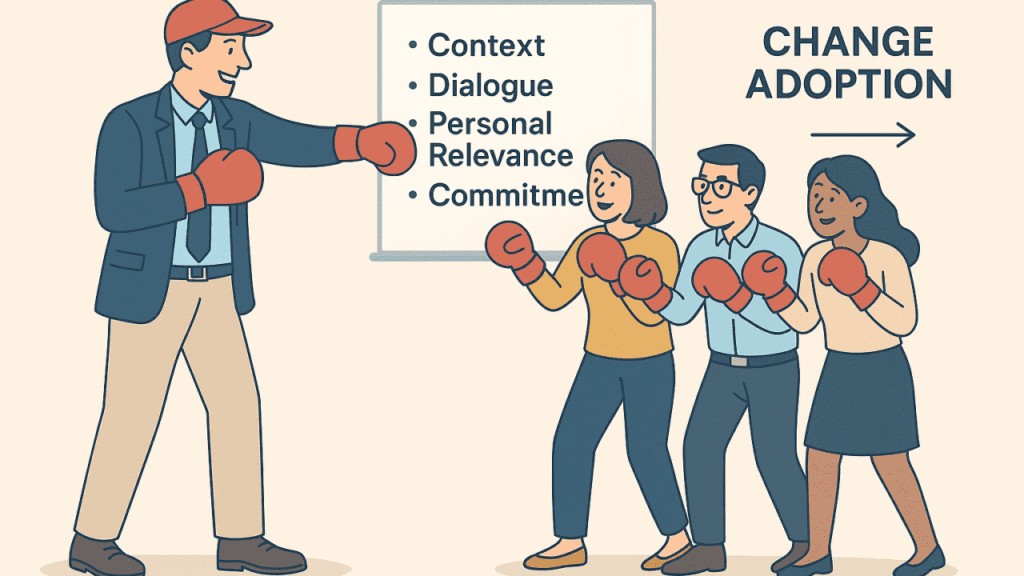
You’ve done the stakeholder mapping. The comms plan is solid. Leadership is aligned.
And yet, three months in, your initiative is quietly grinding to a halt.
The culprit isn’t strategy. It’s not even resistance in the traditional sense. It’s something more fundamental: your people are operating in a state of chronic threat response, and no amount of well-crafted messaging will fix that.
And if you’re a change agent, you know this feeling particularly well—because when the initiative stalls, it’s rarely the strategy that gets blamed. It’s you.
As change agents, we’re trained to manage processes, timelines, and adoption curves. But we’re rarely taught to manage the physiology of change—the way continuous disruption accumulates as unmetabolized strain in the people we’re asking to adapt.
When people fear losing status, certainty, or competence, they don’t rebel openly. They go quiet. They smile in town halls and disengage in practice. They withhold the early warning signals you desperately need to hear. This is the “anxiety “zone”, and most change initiatives are running straight through it without realizing it.
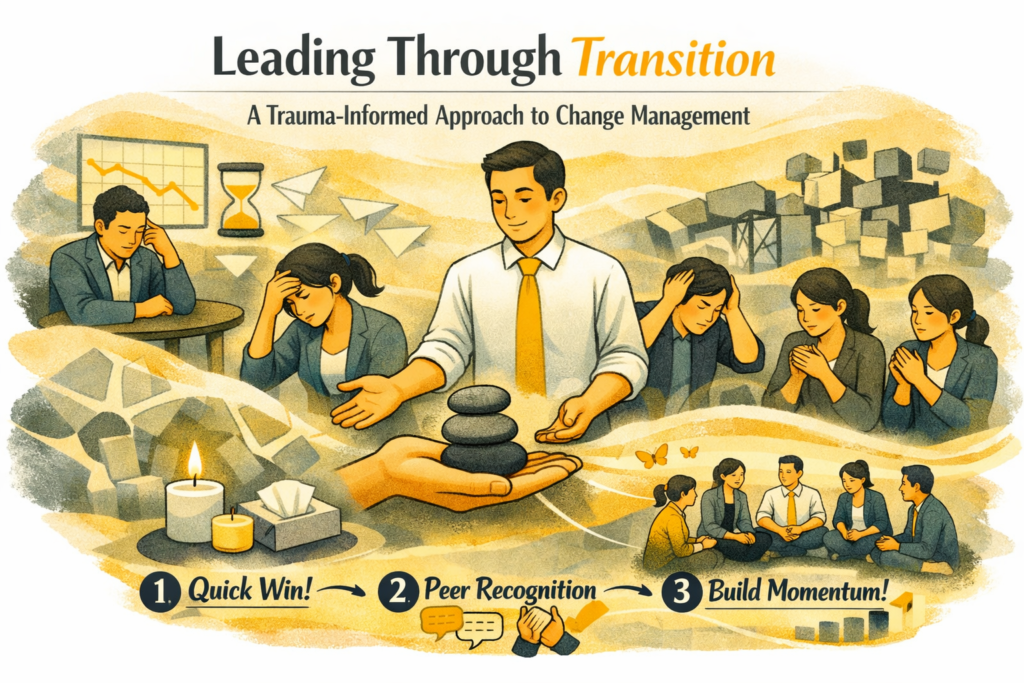
The shift we need isn’t a better change model. It’s a trauma-informed lens on how we lead through transition.
Three Practices to Help Your Workforce Metabolize Change
These practices are drawn from what works in real organizations, under real pressure. You don’t need a formal OCM certification to use them. You need a willingness to lead differently.
1. Set the Stage — Before You Set the Agenda
Frame the change explicitly and honestly. Say out loud: “We don’t have all the answers yet, and intelligent failures are part of how we’ll learn.” Define what will remain stable , the commitments, values, and structures that won’t shift, so people have something to anchor to while everything else moves.
Psychological safety isn’t built through trust-falls. It’s built through consistent, transparent communication—repeated at every milestone, not just at kickoff.
This is something you can do in your very next team meeting, regardless of what leadership has or hasn’t said.
2. Invite Participation — Practice Situational Humility
The most dangerous assumption a change agent can make is that projecting certainty builds credibility. The opposite is true. Openly admitting the limits of your knowledge is an invitation for your team’s expertise to surface.
Create structured spaces where people can process the emotional weight of transition without judgment. This could be a weekly pulse check, a 15-minute “what’s not working” slot at the end of your standup, or a simple open office hour. It doesn’t have to be elaborate.
The goal is to create what researchers call “nesting grounds”—reliable, low-stakes spaces where people feel safe enough to say what’s actually happening. Think of it as your early warning system.
3. Respond Productively — Meet People Before You Fix Them
When someone voices change fatigue or surfaces bad news, the instinct is to respond with logic and solutions. Resist it.
When people feel genuinely acknowledged, not managed, not redirected, but actually heard, their defensive response settles. Only then can they reengage with problem-solving. It works, and here’s why: the brain cannot process complex change when it’s in threat mode. Acknowledgment is the off-ramp.
Appreciation before analysis isn’t a soft skill. It’s the most practical tool in your kit.
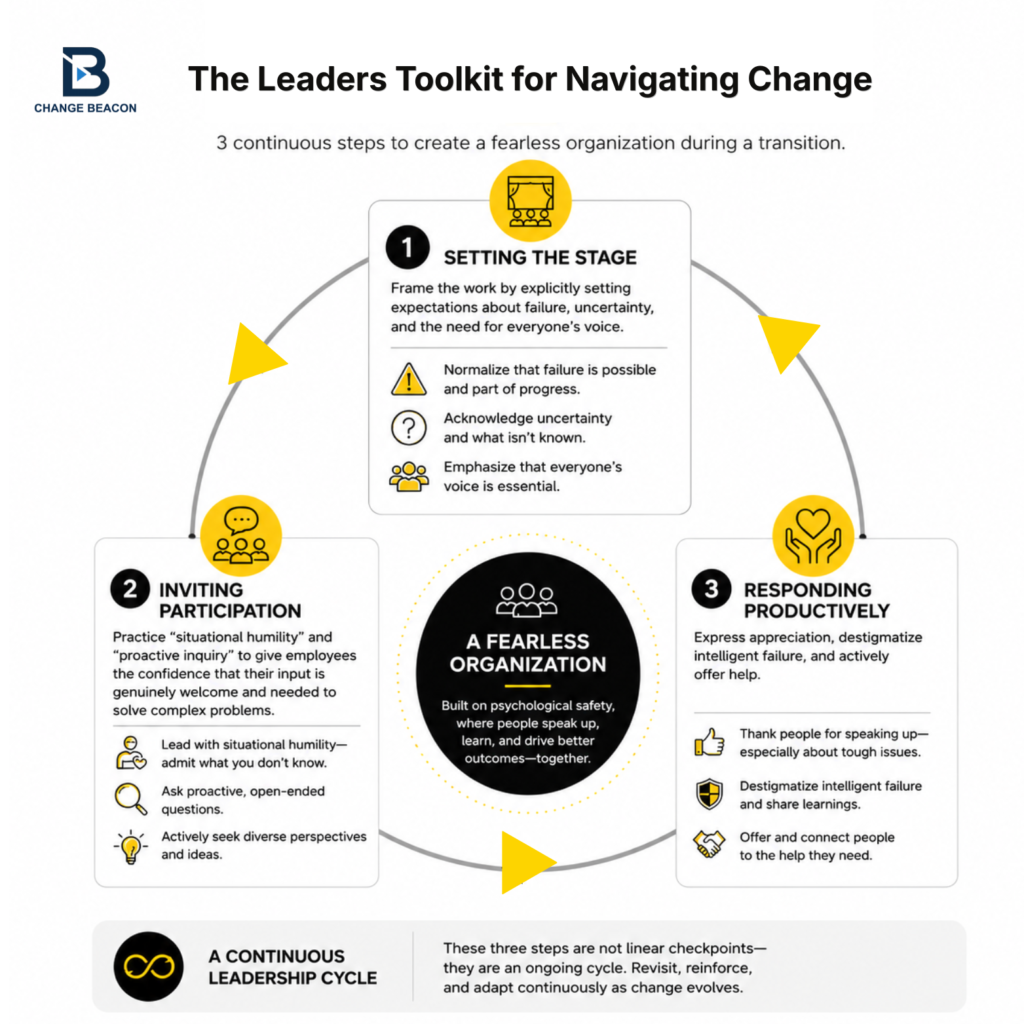
Source: Adapted from McKinsey (2026), A Continuous Leadership Cycle
You Don’t Need a Mandate to Start
These three practices aren’t a linear checklist. They’re a continuous cycle, one you’ll revisit at every phase of the transition, not just at launch.
And here’s what matters most for change agents specifically: you don’t need sign-off from the top to begin. You can start with how you open your next check-in. With how you respond when someone tells you the rollout isn’t working. With one honest conversation about what’s uncertain and what isn’t.
| Organizations that embed psychological safety into their change process don’t just achieve better adoption. They build something that outlasts any single initiative — a team that knows how to move through uncertainty together. That’s built one interaction at a time, by change agents like you. |
Over to You
Have you ever led—or lived through—a transformation where people were expected to “move on” before they’d had time to process what was actually changing?
What helped build trust during the transition? And what made it harder?
Drop your experience in the comments. Especially if you’re in the middle of a transition right now, not leading it from the top but running it on the ground—your perspective is exactly what this community needs to hear.
Want to explore how some practices can be integrated into your organization’s change approach? Explore the Certified Change Agent (CChA) program or download the free CAPG.
#ChangeBeacon #ChangeManagement #OrganizationalChange #Leadership #ChangeLeadership #Transformation #FutureOfWork #OrganizationalDevelopment #WorkplaceCulture #LeadershipDevelopment
References:
Edmondson, A. C. (2019). The Fearless Organization: Creating Psychological Safety in the Workplace for Learning, Innovation, and Growth. John Wiley & Sons, Inc.
Lavoie, J., Srinivasan, R., Lyons, M., & Rabhan, Y. (2026, April). How leaders can help their organizations metabolize strain. McKinsey Quarterly.