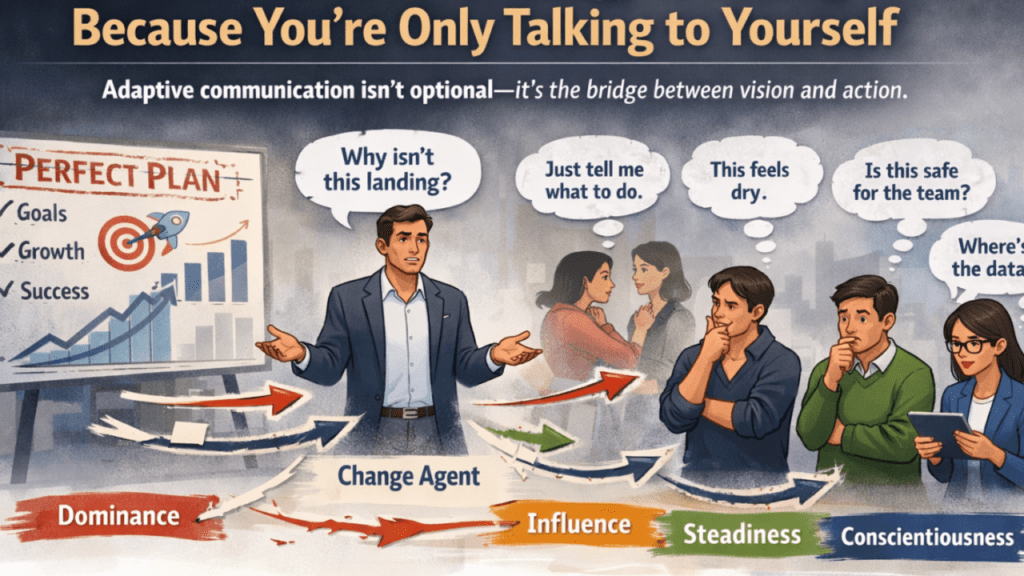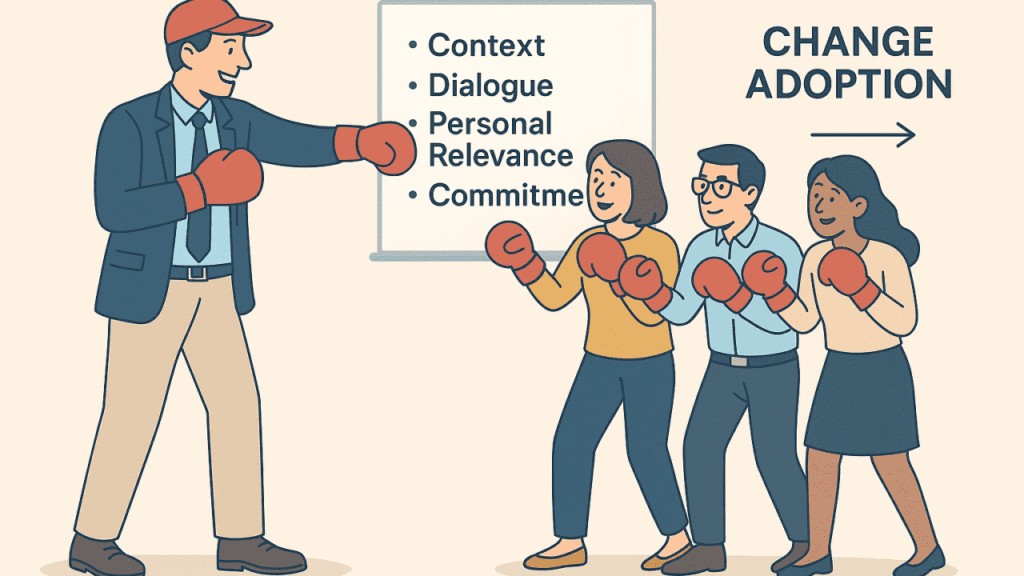
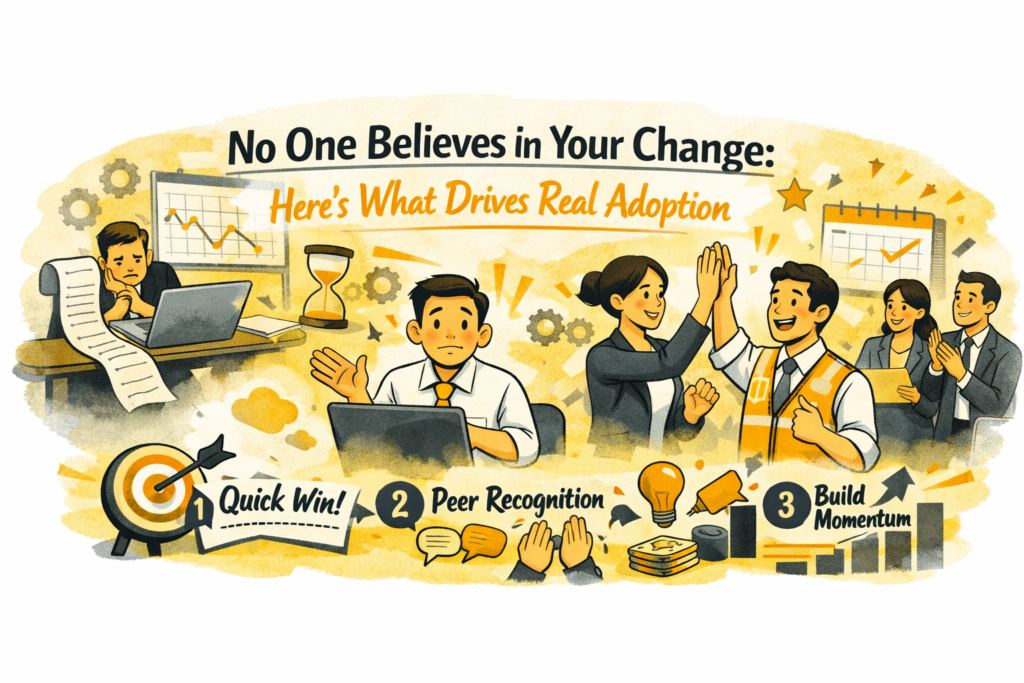
In many organizations, change is framed as something large and strategic, its reflected by a transformation program, a system overhaul, a restructuring that demands significant energy and coordination. This framing can unintentionally make change feel heavy and intimidating. When people imagine a massive shift that disrupts routines and adds pressure, they may feel anxious or disengaged. Yet for those who must live the change, transformation is not experienced as something grand; it is experienced daily, operationally, and sometimes inconveniently. That is why translating enterprise-wide ambition into small operational wins—especially around go-live—becomes critical, especially for frontline Change Agents.
Most Change Agents are trained to understand the broader change roadmap and the frameworks behind it. However, fewer are equipped with a disciplined method to intentionally create visible, peer-level momentum on the ground, even though sustained adoption depends heavily on it. This is precisely why short-term wins matter.
In Leading Change, John P. Kotter emphasizes the importance of generating short-term wins to build credibility, silence cynics, and reinforce the change effort. Small wins are not symbolic gestures; they are strategic accelerators.
Below is a practical protocol Change Agents can use to operationalize that principle.
The 3-Step Small Wins Protocol
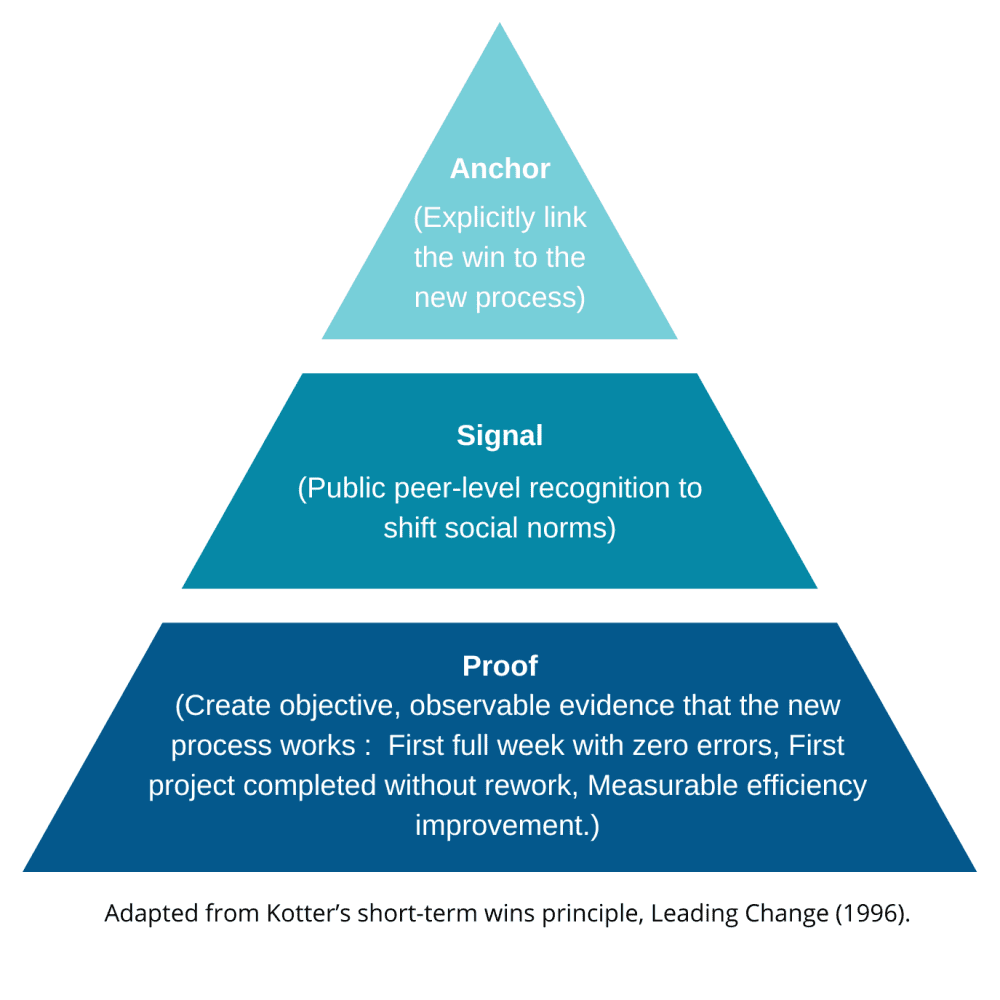
1. Targeted Creation: Design the First Proof Point
Small wins do not happen accidentally. They are engineered.
The Change Agent must identify a specific, observable milestone that clearly demonstrates the new way is superior to the old one. The milestone should be concrete and undeniable.
Examples:
- “First full week with zero errors on the new system.”
- “First project completed using the new template without rework.”
- “First team meeting conducted entirely using the new process.”
The key principle: The win must visibly validate the change.
This shifts the narrative from “management says this is better” to “we just experienced that this is better.”
2. Peer-to-Peer Recognition: Reinforce at the Right Level
Recognition does not need to be monetary. In fact, for early-stage adoption, informal peer-level acknowledgment is often more powerful.
The Change Agent could deliberately highlight the win through:
- A team email shout-out
- A “Win of the Week” printout at the workstation
- A short mention during a team huddle
Why peer-level recognition? Because cultural adoption spreads horizontally before it spreads vertically.
When colleagues see other colleagues succeeding with the new process, the psychological barrier lowers. The change becomes socially normalized.
3. The “Momentum Question”: Link the Win to the Change
Celebrating a win is not enough. The Change Agent must anchor the cause. After the milestone is achieved, the Change Agent should ask: “How did this new process help you achieve this win?”
This question does two things:
- It makes the benefit explicit.
- It rewires attribution from individual effort alone to system improvement.
Without this step, teams may unconsciously attribute success to personal heroics rather than process improvement. The momentum fades. With this step, the link between behavior and outcome becomes clear.
Integrating a Small Failure Protocol
Momentum is fragile. Small signs of resistance, such as someone quietly returning to the old spreadsheet, should not be treated as compliance failures or reporting issues. They are early warning signals.
A disciplined Change Agent applies a Small Failure Check:
- Notice the slip immediately.
- Address it privately and constructively.
- Frame it as coaching, not policing.
- Reinforce why the new process matters.
The goal is simple: prevent micro-relapses from becoming cultural rollback. In change, neglect compounds just as much as progress does.
Final Reflection
Change rarely fails because of poor strategy. It fails because momentum was never built at the operational level. Most change programs don’t fail dramatically, but they fade quietly.
Often because no one engineered the early wins.
In your experience, what was the first visible win that made people finally believe in a change? Let’s discuss on the comment section.
#ChangeBEACON #Leadership #SmallWinsProtocol #Transformation #StrategyExecution #Management
Reference: Kotter, J. P. (1996). Leading Change. Harvard Business School Press.