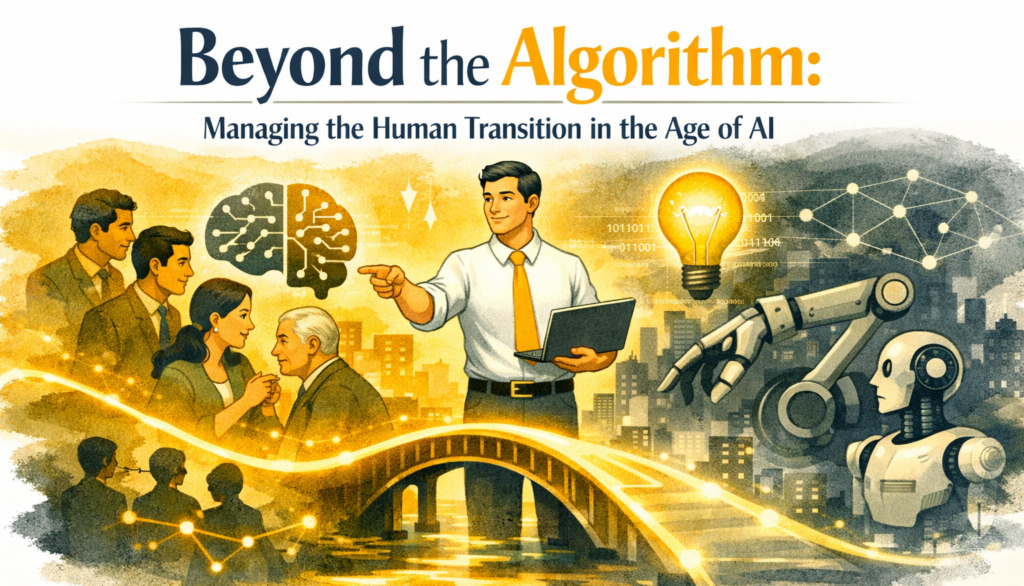
We are standing at the intersection of two realities that rarely move at the same speed: the pace of technological change, and the pace of human adaptation.
The AI revolution is no longer a forecast, it is already reshaping how organizations operate, compete, and create value. And yet, despite the urgency, a McKinsey survey reveals that 86% of leaders admit their organizations are simply not prepared to adopt AI in their day-to-day operations.
This gap between what technology can do and what organizations are actually ready for precisely where our work as change practitioners becomes most critical.
The Real Barriers Are Human, Not Technical
When AI initiatives stall, the instinct is often to look at the technology: wrong platform, poor integration, insufficient budget. But the evidence consistently points elsewhere.
The biggest obstacles to enterprise AI adoption are overwhelmingly organizational: deeply rooted fears about job displacement, siloed departments that resist shared workflows, transformation fatigue from years of back-to-back initiatives, and a persistent lack of clear strategic leadership to anchor the why behind the change.
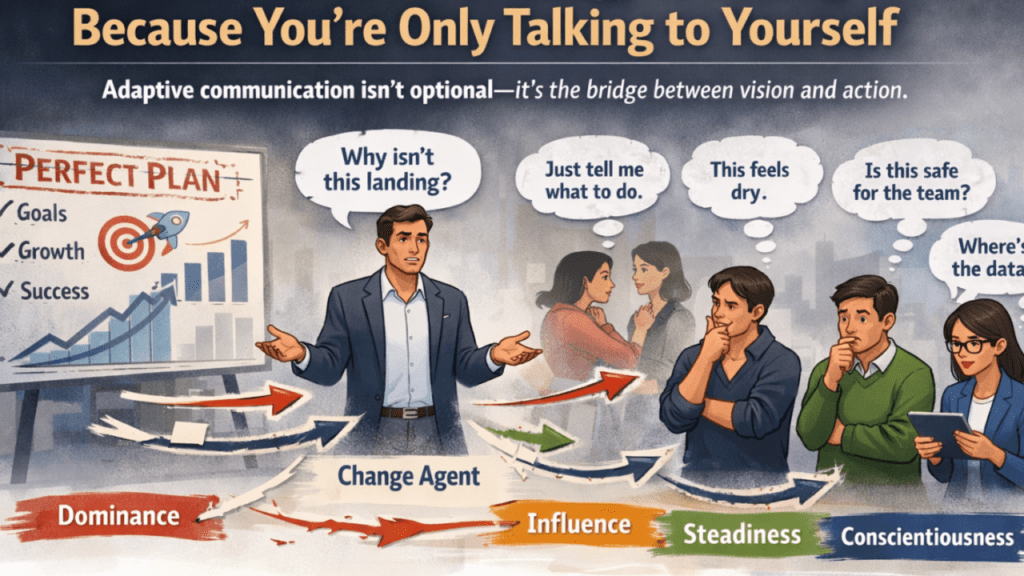
Perhaps most telling, many employees resist not because they reject the technology itself, but because they feel excluded from the process entirely. When people face uncertainty about how AI will reshape their daily work, the psychological default is self-protection. Resistance is not irrational. It is human.
Our Role: More Than Managing Transition
While project managers focus on delivering the technical solution, our function is fundamentally different, we manage the people side of transformation. We ensure the workforce is not just exposed to new tools, but genuinely ready, willing, and able to use them.
In the context of AI, this means serving as a BEACON: Bridging organizational gaps, Educating employees on what AI means for their roles, Advocating for their needs throughout the process, Communicating transparently at every stage, Observing and Overcoming resistance before it compounds, and Nurturing peer commitment so adoption sustains itself from within.
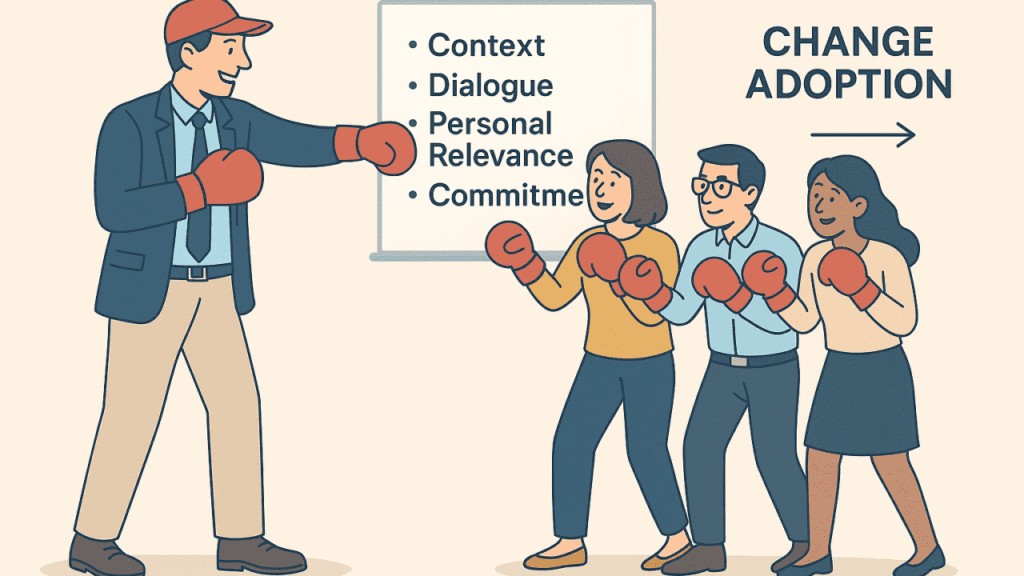
The goal is a fundamental shift in mindset, from AI as a threat to AI as a collaborative partner that amplifies human capability. That shift does not happen through a company-wide email or a one-day training. It is built through consistent, intentional change leadership at every level.
When It Works, the Results Are Undeniable
Effective change management in AI transformation is not a “nice to have” — it is the difference between a failed rollout and a genuine competitive advantage.
Organizations that successfully develop an AI-ready workforce report exponential productivity gains, faster access to decision-critical information, and significantly stronger long-term adoption.
The human transition, when managed well, eliminates the costly delays and quiet disengagement that quietly drain the ROI from even the best-designed AI implementations.
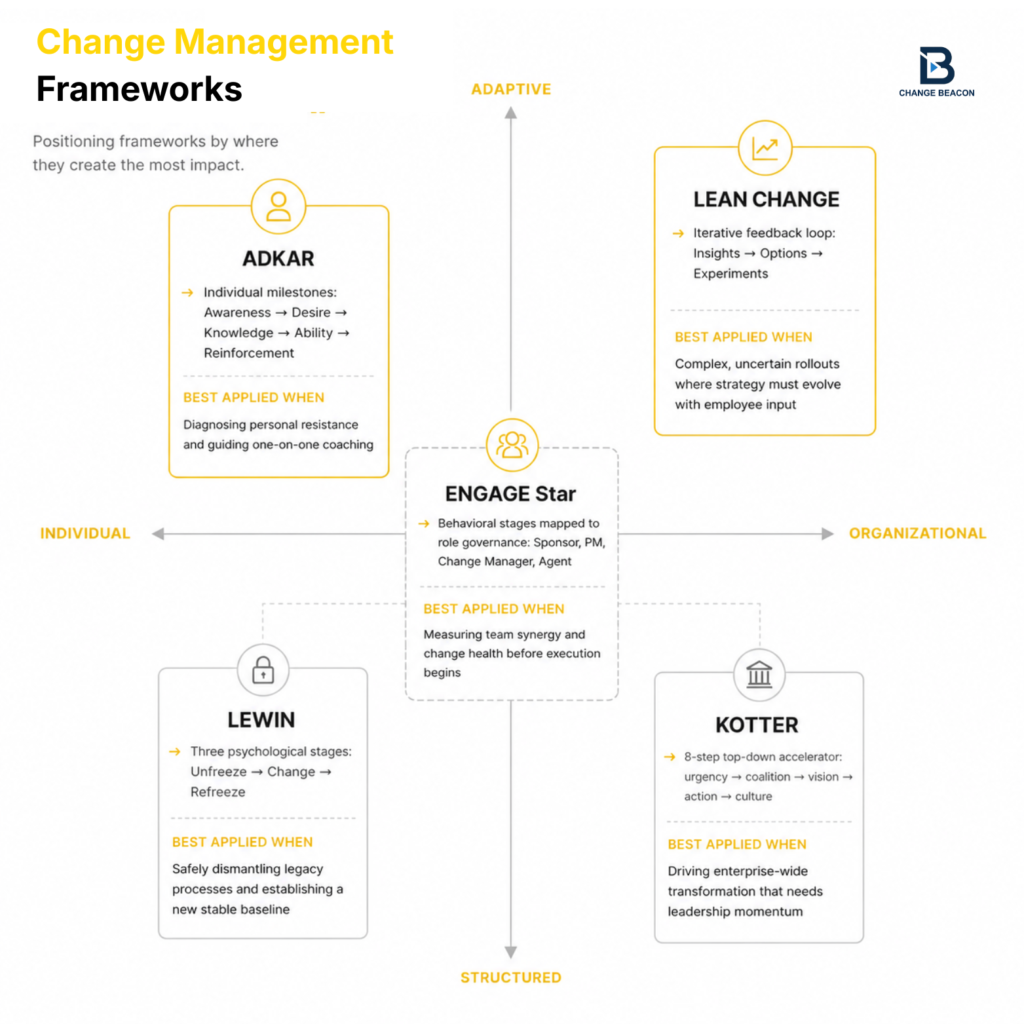
5 Frameworks — Mapped by What They Solve
No single methodology is a silver bullet. The most effective change leaders know which framework to reach for depending on the specific challenge they are facing — and sometimes, they layer more than one.
Think of these five frameworks across two dimensions: who they address (individual vs. organizational), and how they operate (structured vs. adaptive):
The Conversation That Matters
As Change enthusiast we know the frameworks are only as powerful as the judgment behind them. The real skill is in reading your organization, its history, its fault lines, its readiness, and choosing the right entry point.
Which of these models anchors your current practice? And as AI continues to raise the stakes on organizational change, are there approaches here you are looking to bring into your toolkit?
Drop your thoughts in the comments — because the most valuable insights in this field are still being written in the field.
#ChangeBeacon #LeadingChange #AIReadiness #TransformationLeadership #PeopleOverProcess #ChangeAgent #OrganizationalResilience #FutureReady #HumanSideOfAI #ChangeIsHard #WorkplaceTransformation #LeadershipMatters #BuildingBuyIn #ManagingChange
References;
- Buehring, S. (2026). The essentials of Lewin’s change model for successful change management. Knowledge Train.
- Kotter, J. P. (2012). Leading change. Harvard Business Review Press.
- Kotter International. (2024). 8 Steps to accelerate change in your organization.
- Little, J. (2014). Lean Change Management: Innovative practices for managing organizational change. Happy Melly Express.
- Maor, D., Mahadevan, D., Krivkovich, A., Guggenberger, P., Klingler, D., Jeffery, B., Weddle, B., Meijknecht, L., Durth, S., Heimes, H., Ellsworth, D., Srinivasan, R., Gast, A., Di Lodovico, A., Hancock, B., & Schrader, U. (2026). The state of organizations 2026. McKinsey & Company.,
- McKinsey & Company. (2025). The state of AI in 2025: Agents, innovation, and transformation.,
- Prosci. (n.d.). ADKAR: The Prosci ADKAR model for organizational change success. Prosci, Inc.
- Tourista, M., Sutanto, E., & Azwir, A. (2025). Change Health Analysis: A framework for evaluating the readiness and integration of change enablers. International Journal of Social, Policy and Law (IJOSPL), 6(4), 74–82.
- Tourista, M., Sutanto, E., & Azwir, A. (2025). Redefining roles in organizational change: An integrated framework based on the ENGAGE star change model. Journal of Industrial Engineering & Management Research, 6(6), 164–170.