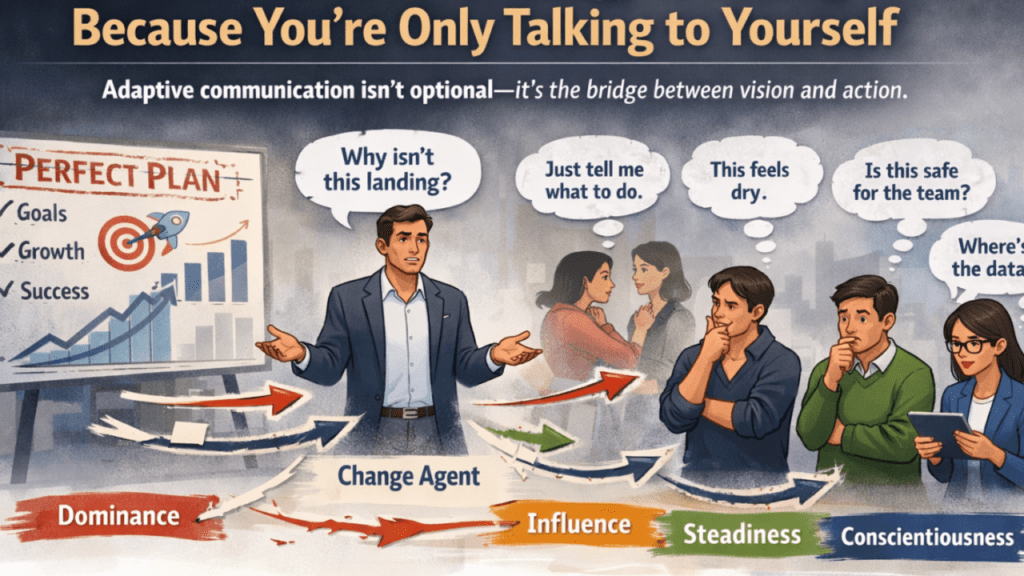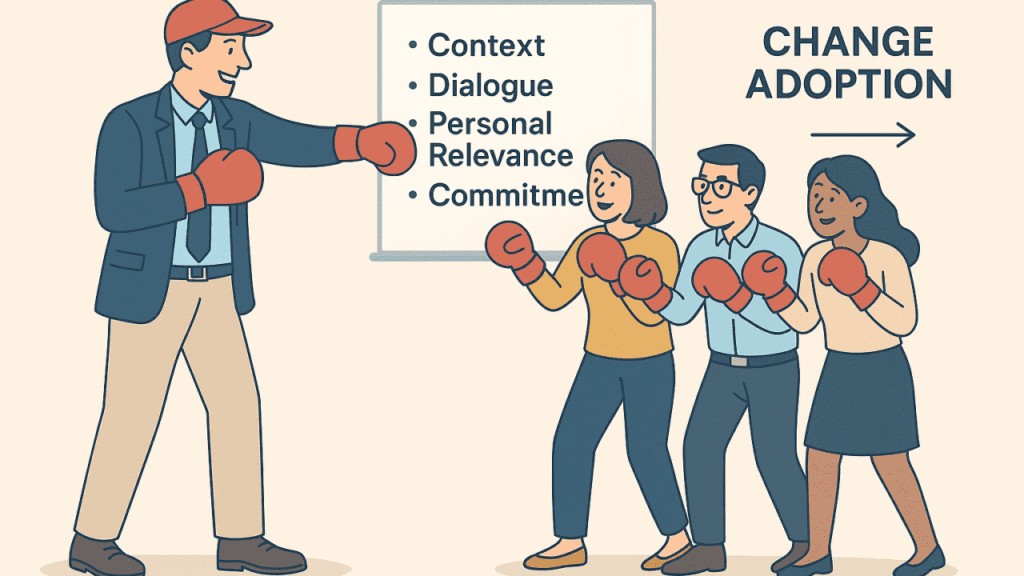

Organizations pursuing transformation initiatives draw on a recurring set of reference models: Lewin’s 3-Step Model, Kotter’s 8 Accelerators, Prosci’s ADKAR, and the newer ENGAGE Star Model. Each has earned a permanent seat in certification programs and consulting methodologies, and each is documented in depth inside the Change Agent Practice Guide (CAPG). Most comparative treatments stop at description, listing what each model contains, without addressing the question that actually determines outcomes: which problem each model is built to solve, and where its problem-solving power runs out.
That question matters most for the Change Agent, the role positioned closest to the front line and responsible for converting strategic intent into day-to-day behavior. Sponsors can plan from Kotter’s sequencing. Change Managers can structure their workstreams around Lewin’s phases or ENGAGE Star’s dual lifecycle. The Change Agent, by contrast, is the one standing in front of a peer who is not doing what the model says they should already be doing, and has to figure out why in real time. Understanding what each model can and cannot do is the starting point for closing that gap.
What follows is a structured comparison of the four models, examined specifically through the demands they place on a Change Agent operating at ground level.
Lewin’s 3-Step Model: Unfreeze, Change, Refreeze
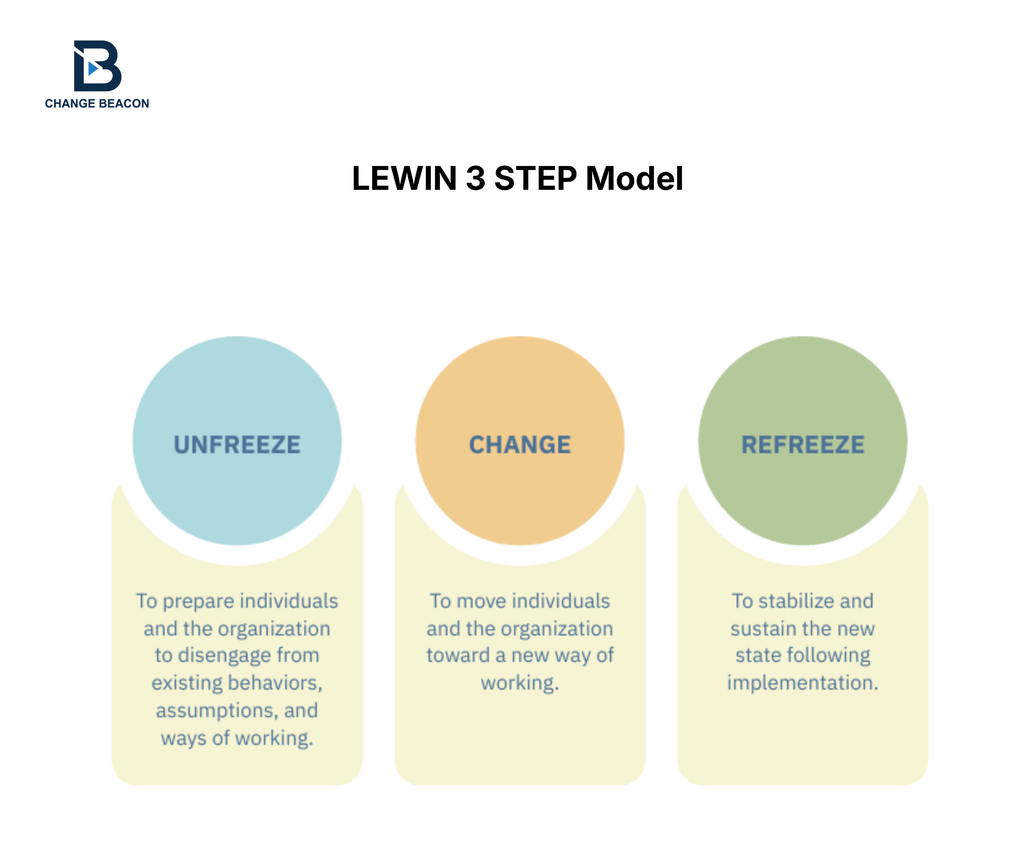
A Change Agent rarely meets Lewin’s model as a diagram. They meet it as a peer who keeps opening the old spreadsheet instead of the new system, three weeks after go-live, not out of defiance but because the old habit is still the path of least resistance. Lewin gives a name for that moment: the individual has not truly unfrozen, or has moved into Change but never reached Refreeze.
Unfreeze reduces attachment to current practice by surfacing why the status quo is no longer viable. Change is the active transition period in which new behaviors are introduced while prior ones are phased out. Refreeze institutionalizes the new behavior as the operating norm. For a Change Agent, Lewin’s real contribution is diagnostic language rather than a task list. It provides a way to name what a peer is experiencing, whether they remain attached to the old process, are actively learning the new one, or are at risk of sliding back, without prescribing what to do about it. The model assumes a definable “before” and “after,” an assumption that rarely survives contact with continuous, fast-cycle operating environments, where the next change often begins before the previous one has stabilized. It also offers no operational guidance on how a Change Agent should actually run an unfreezing conversation or reinforce a refreeze at the team level.
Kotter’s 8 Accelerators: The Leadership-Driven Roadmap
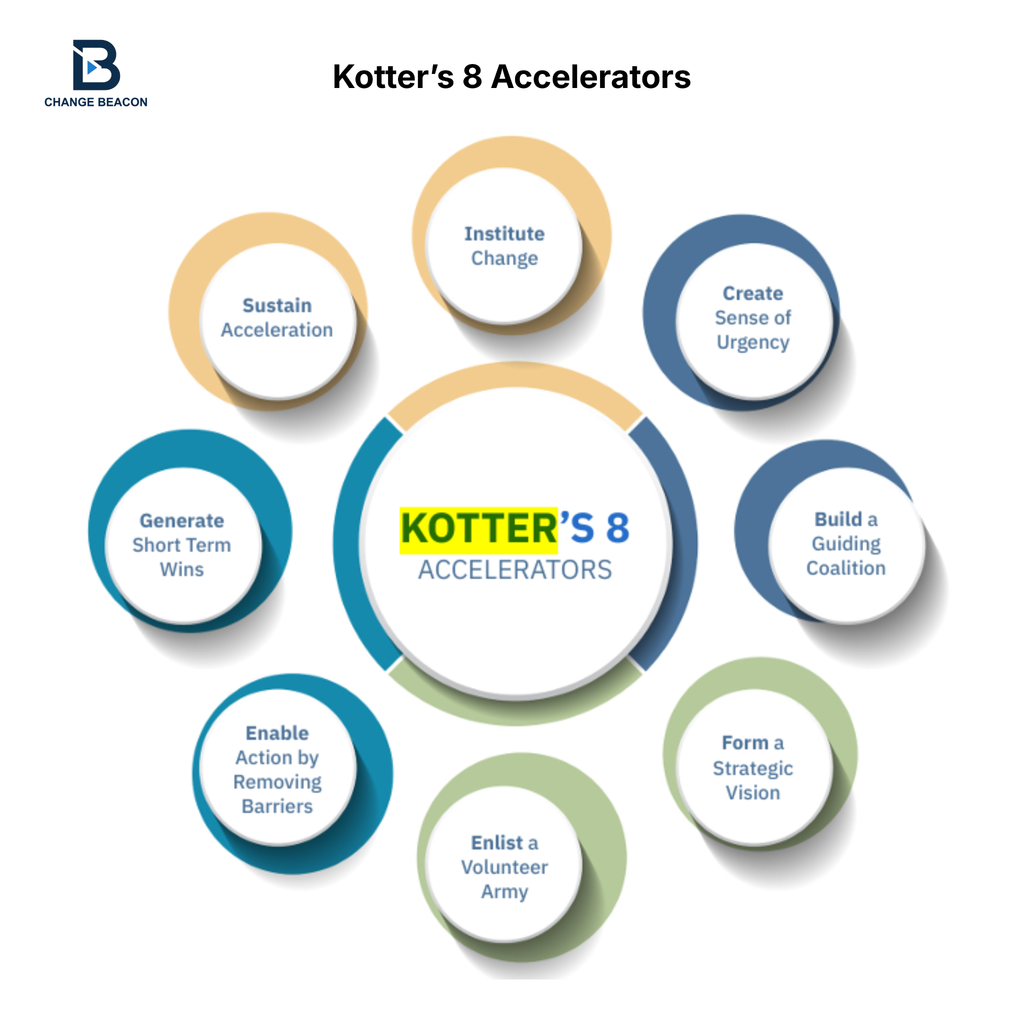
A Change Agent working inside a Kotter-governed initiative does not experience “Build a Guiding Coalition” as a slide in a steering committee deck. They experience it as being asked to identify which two or three peers in their team already believe in the change enough to speak up for it in a team meeting, and then quietly recruiting them before the next resistance flares up. The eight steps set the sequence; the Change Agent supplies the specific names and the specific conversations.
Kotter’s model, creating urgency, building a guiding coalition, forming a strategic vision, enlisting a volunteer army, enabling action by removing barriers, generating short-term wins, sustaining acceleration, and instituting change, was designed for large-scale, enterprise-wide transformation driven from the top. Its practical value for a Change Agent is orientation. Knowing which of the eight steps the organization currently occupies clarifies what the Change Agent’s contribution should look like at that moment. During “Generate Short-Term Wins,” the job is to surface and amplify visible progress inside the assigned team. The limitation is that Kotter is built around organizational and leadership dynamics rather than the internal experience of any one employee. Two peers can pass through the same “guiding coalition” milestone and land at materially different levels of actual behavioral adoption, and Kotter’s framework has no mechanism to detect that divergence. That detection work falls to the Change Agent.
ADKAR: The Individual Adoption Model
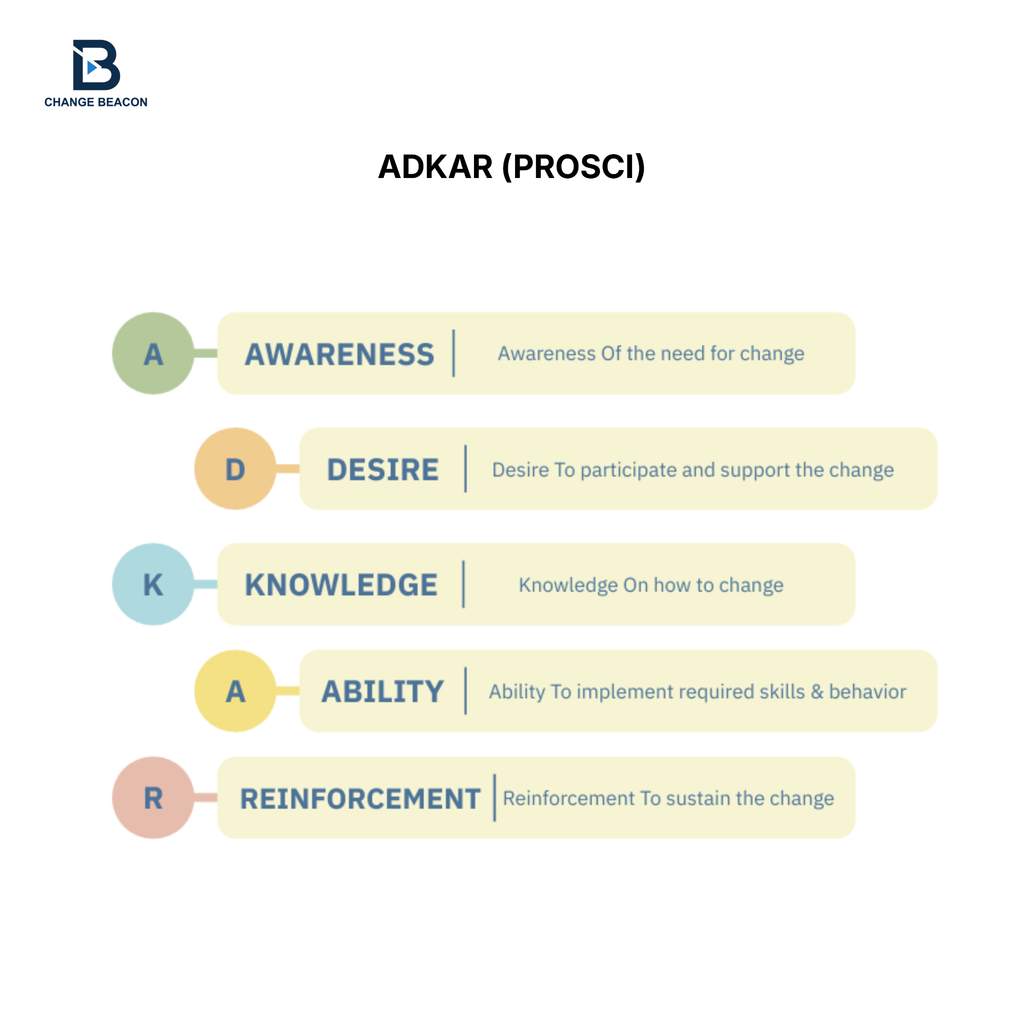
When a peer says “I get why we’re doing this, I just don’t want to,” a Change Agent using ADKAR does not hear generic resistance. They hear a specific diagnosis: Awareness is present, Desire is not, and no amount of repeating the business case will fix it. That distinction changes what happens next, from another explanatory email to a conversation about what the change actually costs that person personally.
ADKAR addresses precisely the gap Kotter leaves open. Rather than describing change as an organizational event, it models change as a sequence experienced by one individual at a time, across five elements: Awareness of the rationale for change, Desire to participate in and support it, Knowledge of how to execute it, Ability to apply new skills and behaviors, and Reinforcement to sustain the change over time. This is the model most directly usable in a Change Agent’s daily diagnostic work, because it forces a specific question rather than a general one every time resistance shows up: is this a lack of Awareness, insufficient Desire, or a capability gap that no amount of motivation will resolve. The corresponding limitation mirrors Kotter’s from the opposite direction: ADKAR offers no organizational sequencing and no guidance on coalition-building. It is built to function alongside a broader change framework, not as a substitute for one.
ENGAGE Star Model: Tracking Two Layers at Once
A Change Agent working inside an ENGAGE Star initiative faces a different kind of complexity. A peer can look ready on the project timeline, the rollout has reached “Execute,” while still sitting in “Guide” on the individual track, meaning they understand the new process conceptually but have not yet been asked to apply it under real conditions. The Change Agent’s task is to notice that mismatch before it becomes a go-live surprise.
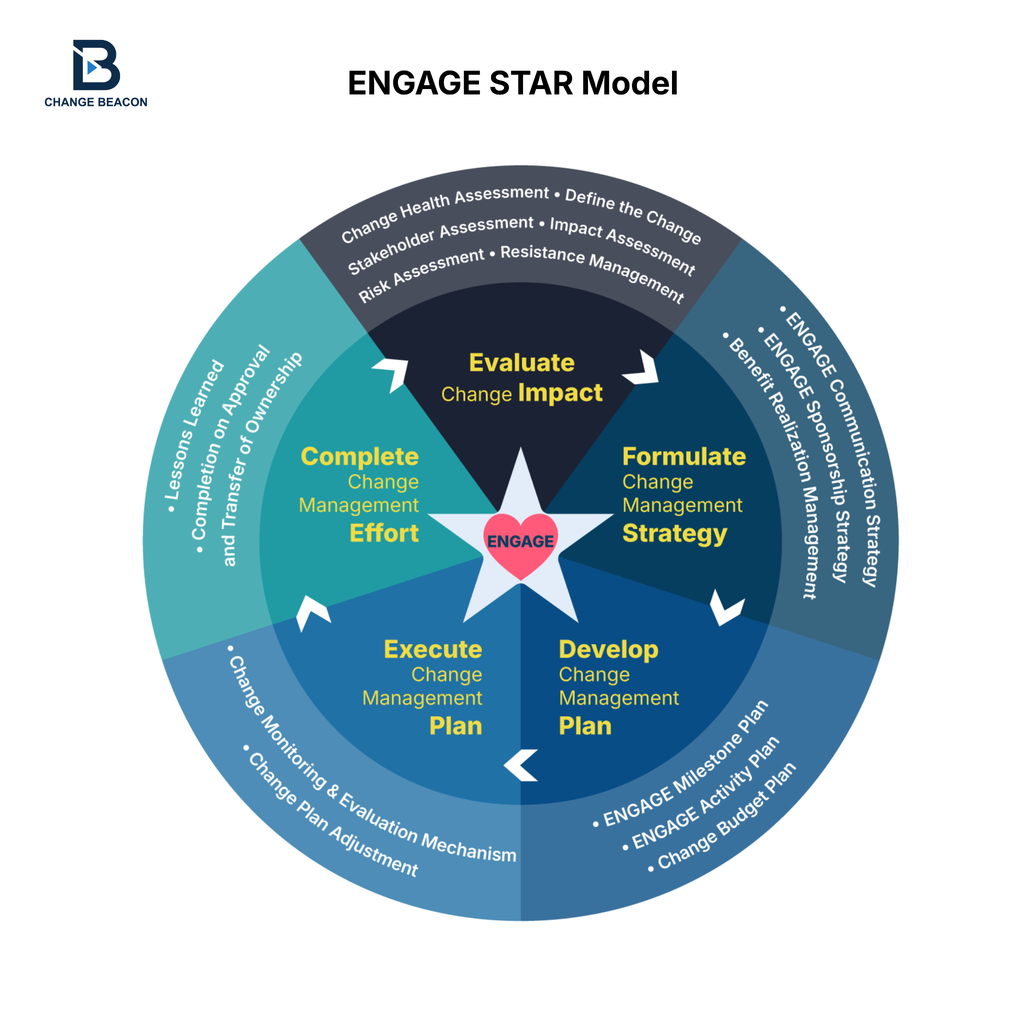
ENGAGE Star pairs five outer, sequential lifecycle phases (Evaluate, Formulate, Develop, Execute, Complete) with six inner engagement stages (Enlighten, Nurture, Guide, Activate, Grow, Embed) that track the individual’s transition alongside the project’s progress. For a Change Agent, this gives a single reporting structure that answers two questions at once: where is the initiative in its lifecycle, and where is this specific peer or team in their personal adoption journey. That dual view is useful precisely because the two layers do not always move at the same pace, and ENGAGE Star is one of the few models built to make that gap visible rather than assumed away. The trade-off is added complexity. Tracking six inner stages against five outer phases for every peer or subgroup is more demanding than applying ADKAR’s five elements alone, and because ENGAGE Star is newer and less widely adopted than Lewin, Kotter, or ADKAR, a Change Agent using it often has less organizational scaffolding, shared vocabulary, prior case examples, established reporting templates, to draw on.
Comparative Summary
| Model | Focus Level | What It Gives a Change Agent | Where It Leaves a Change Agent Exposed |
| Lewin’s 3-Step Model | Individual / small group | A quick, shared vocabulary to name whether a peer is still attached to the old way, mid-transition, or at risk of sliding back | No script for the actual unfreezing conversation or the reinforcement work needed to make refreeze stick |
| Kotter’s 8 Accelerators | Organization-wide / enterprise | A clear signal of which phase the initiative is in, so daily effort is pointed at the right target | No way to tell whether two peers who passed the same milestone actually adopted the behavior at the same depth |
| ADKAR (Prosci) | Individual | A precise diagnostic for exactly where a specific peer’s resistance sits, so the response fits the actual cause | No indication of where that peer’s team sits inside the broader program timeline or coalition structure |
| ENGAGE Star Model | Organizational lifecycle and individual engagement, integrated | A single view that catches the gap between project-phase progress and a peer’s actual readiness | More moving parts to track per peer; less established practice base than the other three models |
The pattern across all four is consistent. Lewin and Kotter address change at the system level: the actions required of leaders and organizations. ADKAR addresses change at the individual level: the sequence one employee must complete. ENGAGE Star tries to hold both levels in view at once. None of them, applied alone, tells a Change Agent what to actually say or do in the middle of a resistance conversation.
No Model Is Universally Correct
A Change Agent rarely selects which model governs an initiative. That decision sits with the Change Manager or the Core Change Team, documented in the Change Management Charter and the Change Management Plan. The more relevant question for a Change Agent is not which model is best in the abstract, but how thoroughly they understand and apply whichever model has already been chosen.
Kotter’s framework assumes a guiding coalition already exists above the Change Agent. ADKAR indicates an individual may be arrested at “Desire.” ENGAGE Star assumes the Change Agent can hold both an outer lifecycle phase and an inner engagement stage in view for every peer at once. In every case, effectiveness depends less on the model’s inherent superiority and more on depth of mastery. A Change Agent who has genuinely internalized whichever model is in play, who can spot a Desire gap versus a Knowledge gap in a five-minute hallway conversation, will outperform one who has only surface-level exposure to all four at once.
Where BEACON Fits
This is the boundary all four models share: they explain how change should move through an organization or an individual, but they stop short of telling a Change Agent how to behave inside a specific peer conversation, a resistance moment, or a go-live week. That operational layer is covered in The BEACON Framework Explained: A Practical Role Model for Change Agents, which breaks the role into six concrete responsibilities, Bridge, Educate, Advocate, Communicate, Observe & Overcome, and Nurture, built to sit on top of whichever macro model an organization has adopted. BEACON does not compete with Lewin, Kotter, ADKAR, or ENGAGE Star. It is the translation layer that turns their diagnostics into daily behavior, the part where a Change Agent decides whether this specific moment calls for Educating a confused peer or Advocating in front of a skeptical one.
Closing the Loop
Return to the question this comparison opened with: which model should a Change Agent use. The honest answer is that the choice was most likely already made before the Change Agent joined the initiative, and no single model was ever designed to carry the full weight of adoption on its own. What determines whether a transformation actually lands is not which model sits at the top of the plan, but whether that model gets translated into daily action, one conversation, one team, one moment of hesitation at a time.
The Change Agent Practice Guide (CAPG) walks through Lewin, Kotter, ADKAR, and ENGAGE Star in greater depth, including how each is applied in practice, so Change Agents can work from whichever model their organization has already chosen with genuine command of it. The guide is a 188-page resource, available at no cost.
#ChangeBeacon #ChangeManagement #ADKAR #KotterModel #LewinModel #ENGAGEStarModel #ChangeAgent #OrganizationalTransformation #ChangeLeadership #ProsciADKAR #ChangeManagementModels #BusinessTransformation #ChangeAdoption
References
- Burnes, B. (2004). Kurt Lewin and the planned approach to change: A re-appraisal. Journal of Management Studies, 41(6), 977–1002.
- Change Beacon. (2026). Change Agent Practice Guide (CAPG) (1st ed.). Change Beacon Center of Excellence for Change Management.
- Hiatt, J. M. (2006). ADKAR: A model for change in business, government, and our community. Prosci Learning Center Publications.
- Kotter, J. P. (2012). Leading change (with a new preface by the author). Harvard Business Review Press.
- Kotter, J. P. (2014). Accelerate: Building strategic agility for a faster-moving world. Harvard Business Review Press.
- Lewin, K. (1951). Field theory in social science: Selected theoretical papers. Harper & Row.
- Tourista, M., Sutanto, E., & Azwir, A. (2025). Redefining roles in organizational change: An integrated framework based on the ENGAGE Star Change Model. Journal of Industrial Engineering & Management Research, 6(6), 164–170. https://doi.org/10.7777/jiemar.v6i6.663