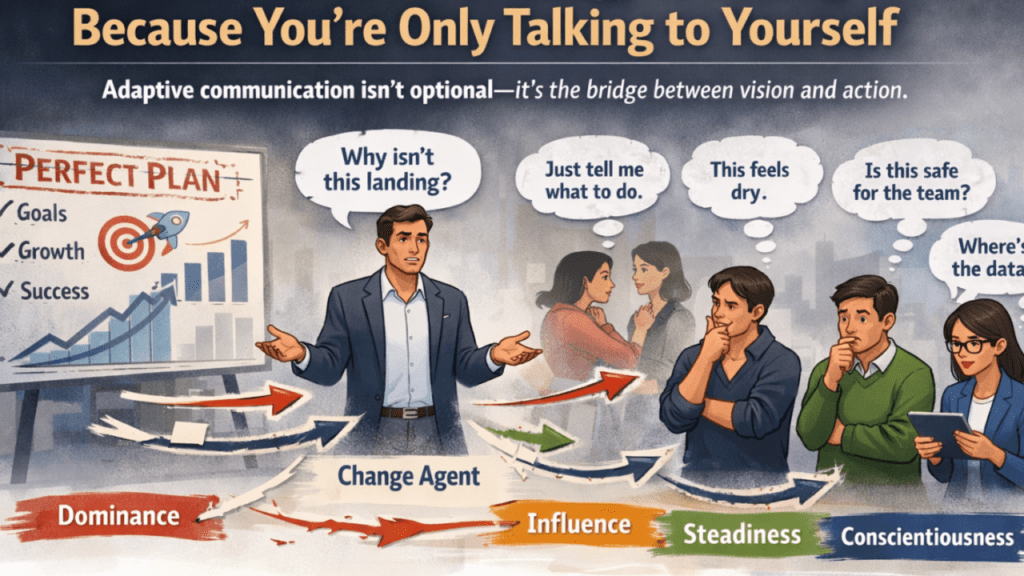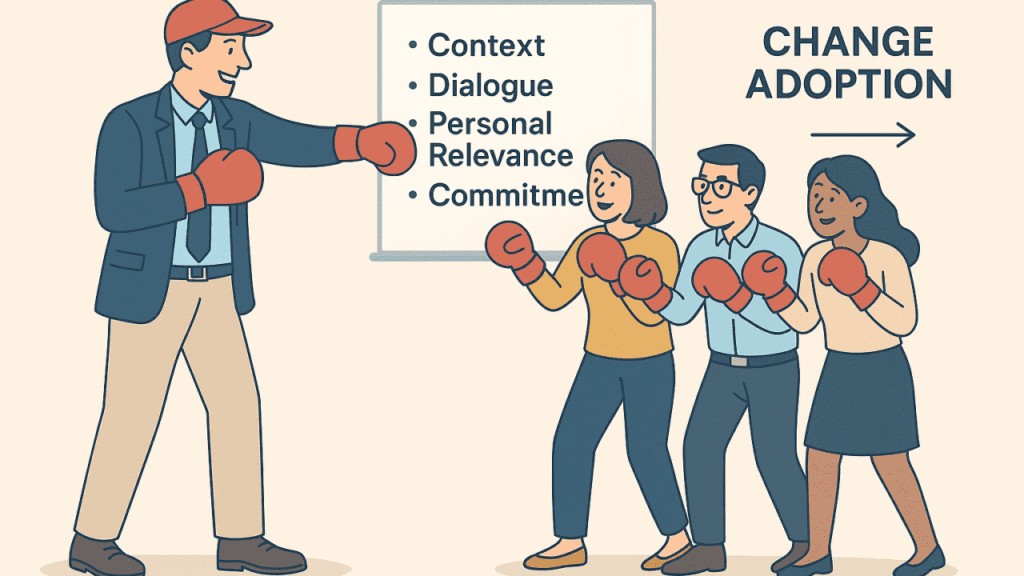

Most organizations do not struggle with designing change. They struggle with what happens after the design is approved: the point where a new system, process, or structure has to survive daily work. New ways of working get introduced, communicated, and trained on, and initiatives still fall short, not because the solution was flawed, but because the people expected to use it never fully understood, accepted, or applied it in practice. Adoption is a human-led process, not simply a technical rollout, and that distinction is where most transformation value quietly disappears.
According to McKinsey’s research on transformations, fewer than a third of organizations report success at both improving performance and sustaining it over time, and even the ones that succeed typically capture only about two-thirds of the financial benefit they set out to achieve. The rest is left on the table, not because the strategy was wrong, but because of what did or did not happen once execution began.
This is the gap the Change Agent role exists to close. While leaders set direction and project teams design solutions, change only becomes real once individuals within the organization understand what is changing, accept why it matters, and apply the new way of working in their daily activities. Before going further into how the role operates, it helps to start with a clear answer to a simple question: what is a Change Agent, exactly, and how is the change agent role different from the other roles it so often gets mistaken for?
What Is a Change Agent?
A Change Agent is an individual embedded within an operational team who helps translate organizational change into daily work. They operate close to the workforce as a trusted peer rather than an outside expert, and their influence comes from credibility and shared operational reality rather than positional authority.
The change agent role typically involves three things: helping colleagues understand the change, supporting the transition to new ways of working, and reinforcing the desired future state. Just as important, a Change Agent is not a one-way messenger; part of the role is feeding observations back from the operational environment, so challenges surface early. The Change Agent Practice Guide (CAPG) frames this as a role for people who operate close to the execution of work: team leaders, supervisors, subject matter experts, business representatives, and members of project or transformation teams, whether or not they hold a formal change management title.
Change Agent vs Change Manager, Project Manager, Sponsor, and Stakeholder
One of the most common sources of confusion in change work is that these terms get used interchangeably. Each one describes a different position in the same system, and understanding where they differ makes it easier to see exactly what a Change Agent is responsible for.
Sponsor: the accountable leader who defines the change, authorizes funding and resources, and demonstrates commitment by consistently modeling desired leadership behaviors. The Sponsor answers why the change is happening at all.
Project Manager: responsible for delivering the technical and operational components of the change, meaning scope, schedule, cost, and quality, while aligning timelines with change management activities. A Project Manager can deliver a solution successfully and still have no bearing on whether people actually use it.
Change Manager: often described as the architect of adoption, accountable for designing and executing change management strategies that address the human and organizational dimensions of the transition. The Change Manager works at the level of the whole initiative.
Stakeholder: an individual affected by the change. In the context of a Change Agent, this most often refers to the peers, team members, and local groups whose day-to-day operations are directly impacted, in other words, the people a Change Agent is there to support.
Change Agent: distinct from all four of the roles above because it is not defined by authority or accountability for outcomes, but by proximity. A Change Agent relies on credibility and shared operational reality, rather than positional authority, to enable, reinforce, and sustain change at the local level.
Seen together, the Sponsor authorizes the change, the Change Manager designs how it will be adopted, the Project Manager builds and delivers the solution, and the stakeholders are the people living through it. The Change Agent is the connective layer between all of them, close enough to stakeholders to understand their reality, and close enough to the initiative to keep translating its intent as conditions shift.
Why the Change Agent Role Is Crucial
A new process, system, or structure does not generate value simply by existing. Organizational change only delivers value when it is adopted and sustained; implementation alone does not produce business benefits. Value is realized only when people understand, adopt, and consistently apply the new way of working in their daily roles. Positioned this way, the Change Agent functions as a value driver: not the person who authorizes the change or designs the solution, but the person whose day-to-day influence determines whether the intended value is actually captured.
This pattern shows up clearly in the data. According to McKinsey, on average 55 percent of a transformation’s value loss happens during and after implementation, well past the point where the strategy was already signed off, and roughly a fifth of that loss occurs only after a solution has gone live and the project team has moved on. Sustaining a result turns out to be harder than achieving it in the first place.
Consider a company rolling out a new IT system across its branches. The technical build finishes on schedule, training sessions are delivered, and the project is formally closed. From a delivery standpoint, the rollout succeeded. But without someone at the branch level reinforcing the new way of working once the project team moves on, employees often drift back to older, more familiar habits, and the value the system was meant to unlock never fully shows up in daily operations.
A similar pattern shows up in organizational restructuring. A new reporting line can be drawn cleanly on a slide, but habits like who people go to for decisions and how teams coordinate do not shift just because the org chart changed. In both scenarios, success depends less on the quality of the design than on whether someone close to the work is actively helping colleagues move from the old way of doing things to the new one.
This is what the Change Agent contributes throughout the change lifecycle: building awareness and desire, supporting new skills, identifying and addressing resistance, and reinforcing new ways of working until they hold on their own. By raising real operational challenges early, a Change Agent helps ensure that issues affecting adoption get addressed while they are still small.
Core Principles of an Effective Change Agent
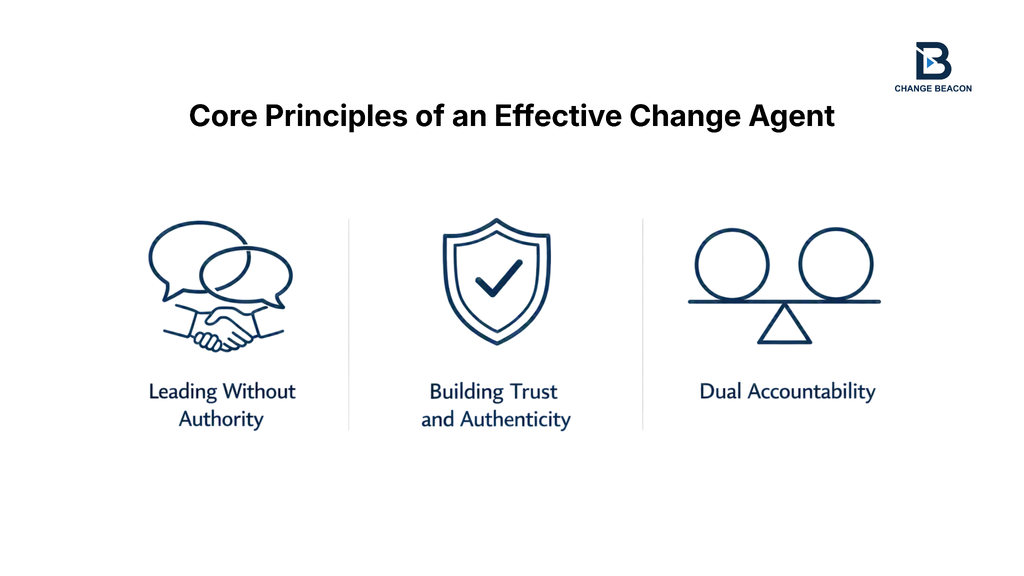
Being assigned the title is not the same as performing the role effectively. A Change Agent’s impact is often limited by position, job title, or formal authority; in most organizations, they are not responsible for approving budgets, assigning work, or evaluating performance. What they are expected to influence instead is something more complex: how people think, feel, and behave during change. Three core principles describe how an effective Change Agent operates in practice.
1. Leading Without Authority
Leading without authority means leadership driven by influence, relationships, and shared purpose rather than formal position or control. No single role holds all the authority needed to drive change on its own, so leadership becomes a matter of impact rather than hierarchy. For a Change Agent, this starts with genuinely understanding what matters to the other person, their priorities and pressures, so that a conversation about change is framed around mutual benefit rather than compliance. Influence built this way tends to hold up far better than anything driven by title alone.
2. Building Trust and Authenticity
For a Change Agent, trust is not a soft interpersonal factor; it functions as a practical, developable capability that directly affects execution speed and how honestly people share what is actually going wrong. Trust rests on four sources: integrity, meaning what a Change Agent says and does are consistent; intent, meaning their motives are read as mutually beneficial rather than self-serving; capabilities, meaning they can genuinely deliver on what they promise; and results, a track record others can verify. A Change Agent who is well liked but unreliable, or capable but self-interested, will struggle to sustain trust over time.
3. Dual Accountability
A Change Agent carries two responsibilities at once: as a member of their own team, and as a representative of the change initiative. As a team member, they experience the same disruptions as their colleagues and understand the informal norms and resistance drivers that formal plans often miss. As a representative of the change, they reinforce its purpose and escalate risks before they compound. Holding both responsibilities well, rather than collapsing into either one, is what allows a Change Agent to keep a transformation ambitious and workable at the same time.
Competencies a Change Agent Needs
Applying these principles consistently draws on competencies rarely taught in a standard corporate training track. Broadly, they fall into three domains: influencing colleagues without relying on formal authority, guiding and supporting peers while managing interpersonal dynamics; communication, using two-way dialogue rather than one-way messaging and closing the feedback loop with both leaders and peers; and applying change management fundamentals at the team level, from diagnosing local readiness and managing resistance to generating momentum through small wins and supporting formal closure.
Each of these domains is broad enough to warrant its own deeper discussion, which is exactly where the rest of this series picks up.
From Understanding to Practice
A Change Agent is not a ceremonial title assigned in the middle of a project. It is a working role that depends on personal readiness, trainable competencies, and consistency that holds up once the initial energy of a launch fades. This is often where organizations underinvest: they can build a strong roadmap, a solid project structure, and a well-chosen technology stack, and still watch value stall at the local level without an effective Change Agent in place.
The Change Agent Practice Guide (CAPG) was developed as a structured reference for exactly this purpose: it outlines the principles, roles and responsibilities, and practices that help a Change Agent enable adoption, manage resistance, and sustain change within their team, across the full 188-page guide. It is available at no cost and is the primary source behind this article.
For those who want to build this capability formally, the Certified Change Agent (CChA) credential is a natural next step.
Ultimately, the impact of a Change Agent is seen in what happens after implementation: whether people adopt the change, sustain new ways of working, and turn the intended change into everyday value.
References:
1. Change Agent Practice Guide (CAPG), First Edition. Change Beacon, 2026.
2. McKinsey & Company. “Losing from Day One: Why Even Successful Transformations Fall Short.” December 2021.