Nobody tells you this when you step into the role of a change agent: the hardest part is not the strategy. It is not the stakeholder map, the communication plan, or the governance structure. The hardest part is staying grounded when everything around you is in motion and still being the person others look to for direction.
As a change agent, your mandate is to disrupt the status quo and guide the organization toward something better. But what that actually means, day to day, is absorbing resistance, navigating ambiguity, and holding space for people who are afraid, all while managing your own inner turbulence.
To do this well, you need to master two distinct but deeply intertwined domains: yourself, and the mechanics of change itself.
What Is the Human Operating System?
Every organization runs on two systems at once. There is the technical system: the roadmaps, structures, and processes designed to move work forward. And underneath it, running quietly but constantly, is the human operating system, the patterns of emotion, trust, identity, and nervous-system response that determine whether people actually adopt what the technical system is asking of them.
Most change efforts are designed entirely for the technical system. The Change Agent Practice Guide is built specifically to address this gap.They assume that if the logic is sound, adoption will follow. But the human operating system doesn’t run on logic alone; it runs on safety, meaning, and felt experience. Ignore it, and resistance rarely shows up as open disagreement. It shows up as fatigue, quiet disengagement, or compliance without commitment. Work with it deliberately, and transformation moves faster, not because people were convinced, but because the change is no longer fighting their wiring.
This is why mastering yourself and mastering the mechanics of change aren’t two separate skill sets. They are two ways of working with the same underlying system: the human one.
The Inner Game First
Before you can move an organization, you have to be able to move yourself deliberately, not reactively.
Change agents face relentless pushback. And if you are not careful, that pushback gets personal. A stalled project starts to feel like personal failure. A skeptical stakeholder starts to feel like an adversary.
Thibaut Meurisse, in Master Your Emotions, explains why this happens: prolonged negative emotion is rarely about the situation itself. It is the result of a specific loop: Interpretation + Identification + Repetition. You interpret a setback as a threat, you identify with that frustration as if it defines you, and then you replay it. The loop compounds, and suddenly you are leading from a place of depletion rather than clarity.
The antidote is cultivating objective distance. You are not your emotions, they are temporary states passing through, not permanent truths about your capabilities. Shifting your internal narrative from “I am failing” to “I am experiencing a difficult situation” sounds deceptively simple, but it creates just enough space between stimulus and response for strategic thinking to re-enter.
Add to that a conscious breath, a posture reset, a deliberate pause before reacting and you reclaim the mental clarity that change leadership actually demands.
Meeting People Where Their Nervous Systems Are
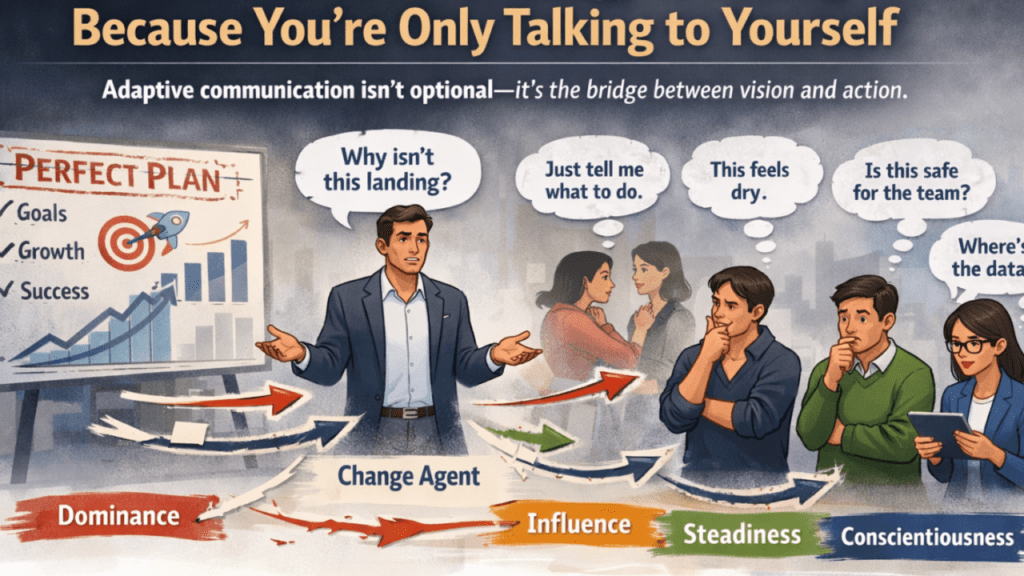
Once you have regulated yourself, your attention turns outward. And here is where many change agents get it wrong: they treat resistance as an intellectual problem requiring a better argument. It rarely is.
When people are facing continuous organizational disruption, their nervous systems enter threat-detection mode. The McKinsey Health Institute found that a significant portion of employees carry unresolved traumatic stress into their work and organizational change, with its implied threats to status, competence, and belonging, activates those stress responses whether anyone intended it to or not.
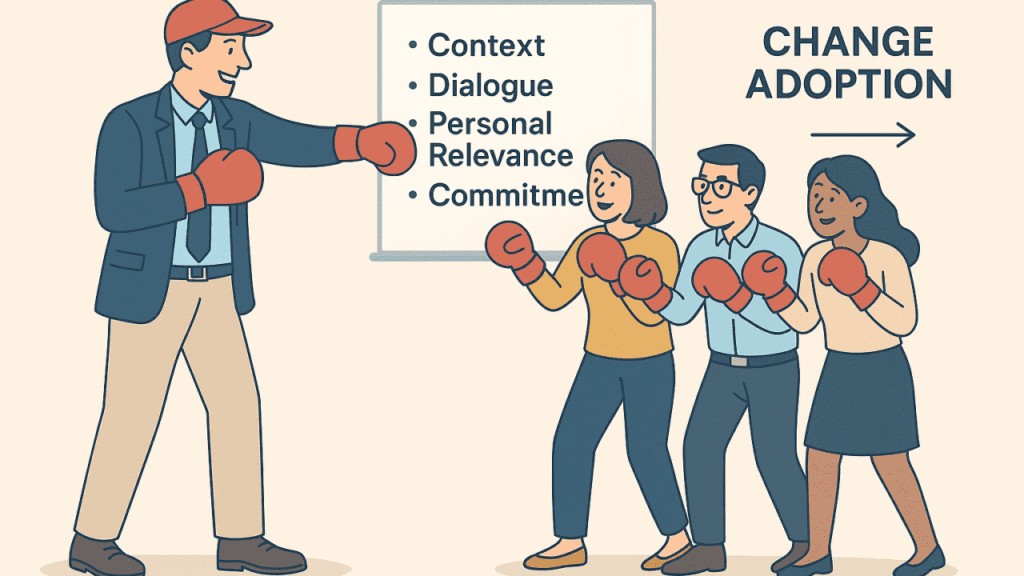
What people need in those moments is not a better slide deck. They need to feel met genuinely seen and acknowledged before they can cognitively engage with what you are asking of them.
As a change agent, this means creating what might be called psychological nesting grounds: consistent forums, honest check-ins, and safe spaces where people can process what is actually happening to them without fear of being dismissed or labeled as difficult.
When you help people metabolize the emotional weight of change, you do not slow the transformation down. You make it stick.
The Mechanics: See It, Feel It, Change It
With relational trust as your foundation, you can focus on execution. And the most common trap change agents fall into at this stage is over-relying on logic. Data is necessary, but data alone does not move people.
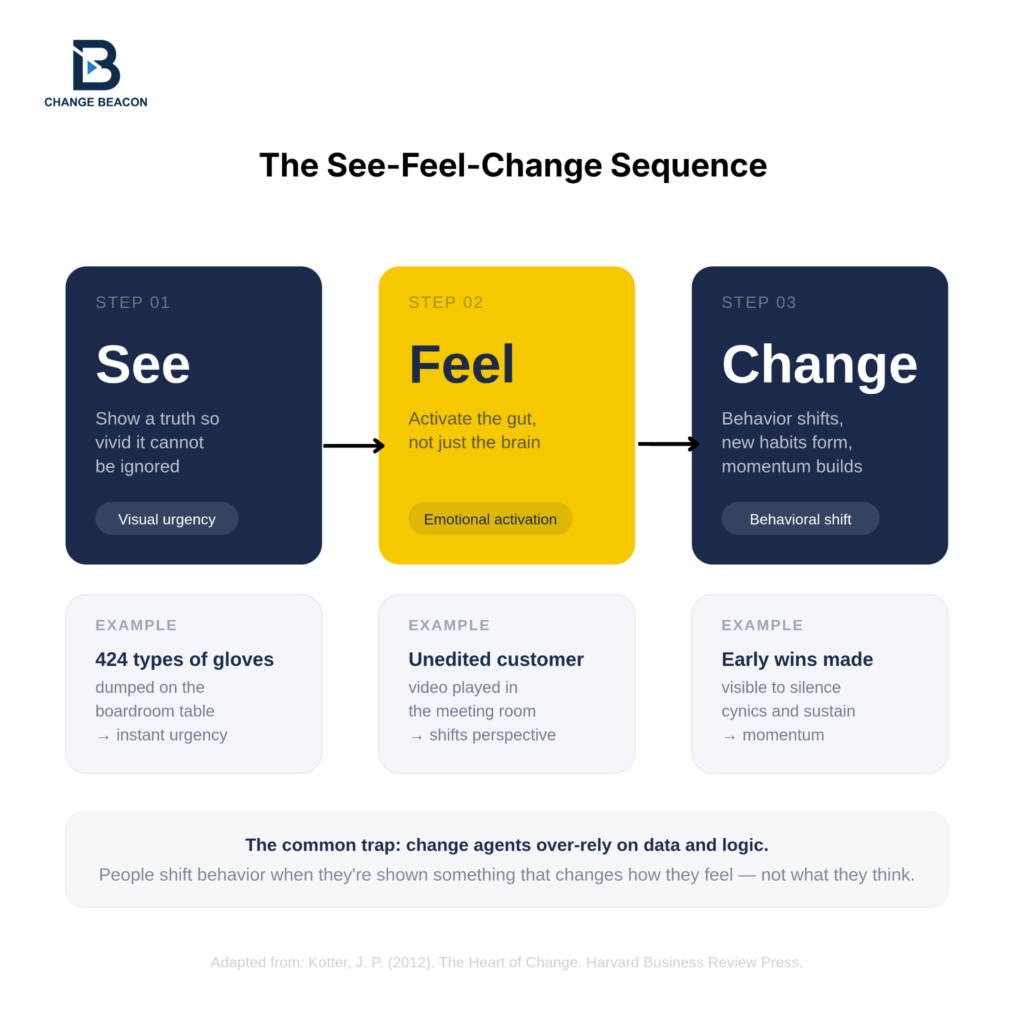
John Kotter’s See-Feel-Change dynamic, detailed in The Heart of Change, cuts to the heart of why. Large-scale behavioral change happens not when people are convinced intellectually, but when they are shown something that shifts how they feel. This principle should shape every tactical decision you make:
- Create urgency visually, not verbally. In one example from The Heart of Change by John Kotter and Dan Cohen, a company discovered it was purchasing 424 different glove variants across its factories, often paying dramatically different prices for gloves that served the same purpose due to fragmented procurement. Instead of presenting the findings in a slide deck, the change team placed the glove samples on the boardroom table. The visual made the inefficiency impossible to ignore, and urgency followed.
- Build a coalition built on trust, not just titles. The guiding team needs credibility and diversity, but more than that, it needs the psychological safety to surface honest disagreement internally before presenting a unified front externally. Communicate to the gut, not just the head. An unedited video of a genuinely frustrated customer will shift perspectives faster than any satisfaction metric ever will. Reach people where decisions are actually made, emotionally.
- Clear the path, then celebrate the early wins. Empowerment means actively removing the structural obstacles, the rigid approver, the outdated incentive system, the process that punishes experimentation, that stand between people and the new way of working. And when the first real wins emerge, make them visible. Early victories are not just morale boosters; they are proof of concept for the skeptics.
The Change Agent’s Edge
What separates a change agent from a project manager is not only the framework or approach they use it is the quality of presence they bring to every interaction. You are not just managing a process. You are holding the emotional architecture of a transformation together while simultaneously dismantling what came before.
That requires you to be regulated enough to stay curious when others are defensive, grounded enough to absorb anxiety without amplifying it, and clear-eyed enough to know when to push and when to simply be present.
At Change Beacon, this is the practitioner depth we are built around — not just equipping change agents with tools, but developing the inner and outer capabilities that make transformation genuinely possible from the inside out.
What has been the most unexpectedly human moment in your change management work? Share in the comments.
#ChangeBeacon #ChangeManagement #ChangeAgent #OrganizationalTransformation #SeeFeelChange #LeadershipDevelopment #EmotionalIntelligence #PeopleAndProcess #TransformationLeadership #ChangeBeacon #HumanCenteredChange #ResistanceManagement #PsychologicalSafety #ChangeAgentLife #EmpatheticLeadership #TransformationJourney
References:
- Kotter, J. P., & Cohen, D. S. (2002). The heart of change: Real-life stories of how people change their organizations. Harvard Business School Press.
- Lavoie, J., Srinivasan, R., Lyons, M., & Rabhan, Y. (2026, April 21). Trauma-informed leadership and resilience: How leaders can help their organizations metabolize strain. McKinsey & Company.
- Meurisse, T. (2018). Master your emotions: A practical guide to overcome negativity and better manage your feelings