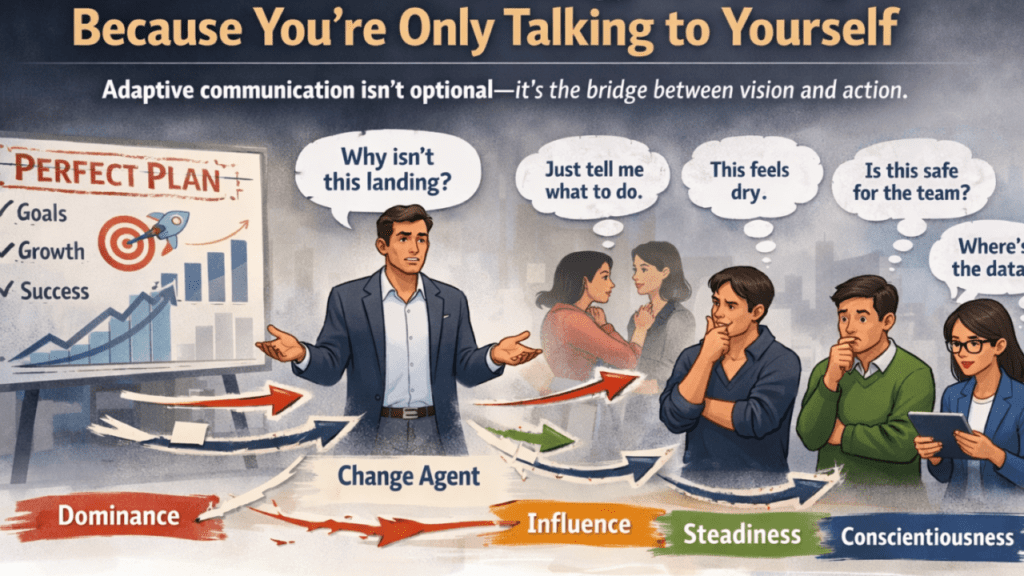

Every Change Agent eventually hits the same wall: the model on the slide is clear, but the conversation happening right now, with a peer who just reverted to the old process under deadline pressure, is not covered by any phase diagram.
A transformation program can have a clean ADKAR roadmap, a fully staffed guiding coalition per Kotter’s playbook, and executive sponsorship signed off in a charter. On paper, the sequence is sound. Yet on the floor, a Change Agent still faces the same question every Monday morning: what do I actually do with the peer who quietly stopped using the new system last week? Strategic models tell an organization where it is going and roughly in what order. They rarely tell the person standing next to a resistant colleague what to say next.
Most strategic models, including ADKAR and Kotter’s playbook, are built to answer questions of direction and sequencing, not to script what happens in a specific conversation between two people. The gap that shows up on the floor is not a flaw in the model itself; it is a natural consequence of a scope that was never meant to go that granular. This is precisely the space the BEACON framework was built to occupy: not another strategic sequence, but a practical, repeatable role model for what a Change Agent does day to day, peer to peer, conversation to conversation.
What BEACON Actually Is
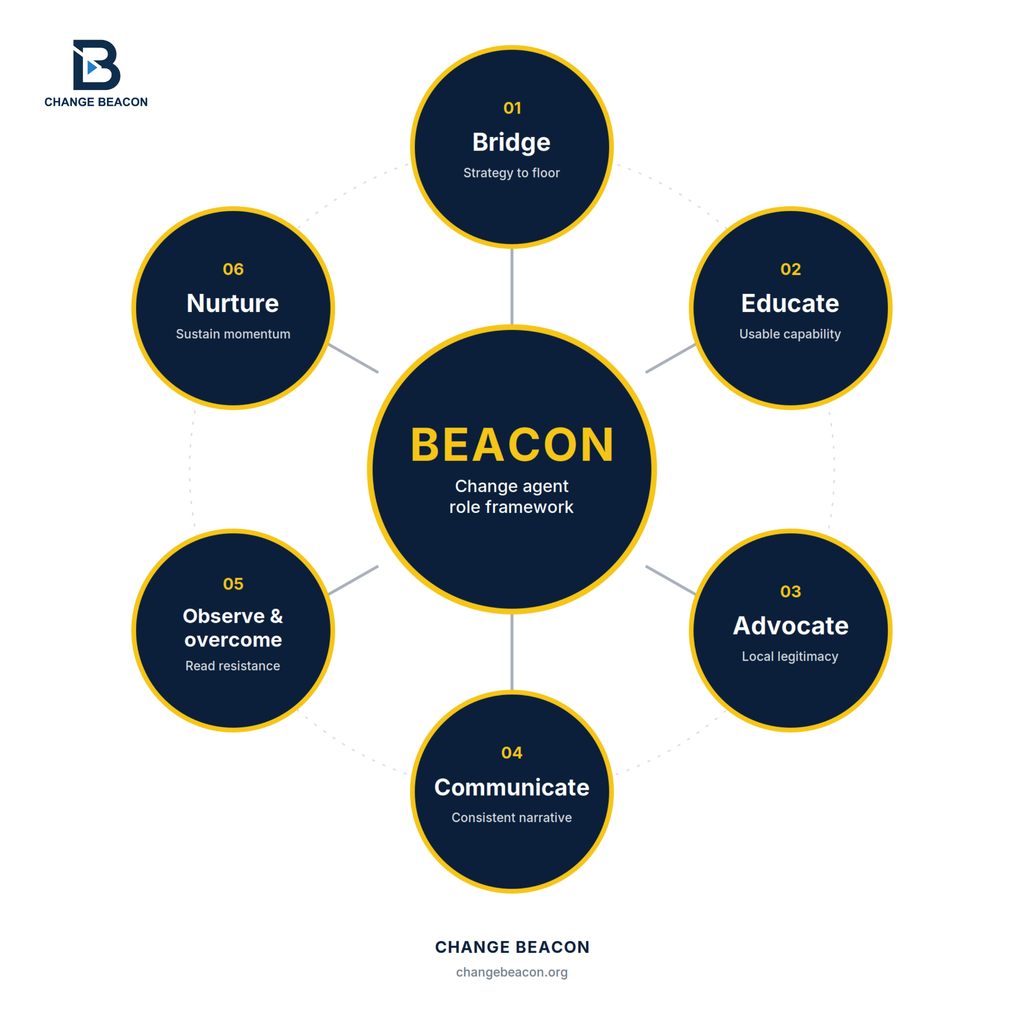
BEACON is not a project methodology and it is not a replacement for the models that define how organizations plan and sequence change. It is a role framework, six interconnected functions that describe what an effective Change Agent consistently does at the operational level, regardless of which strategic model sits above it.
Where Kotter sequences leadership action and ADKAR diagnoses individual readiness, BEACON answers a narrower but more immediate question: in any given interaction with a peer, which behavior does the Change Agent need to bring right now? The six roles, Bridge, Educate, Advocate, Communicate, Observe & Overcome, and Nurture, are not phases executed in strict order. They operate concurrently, applied as the situation demands, throughout the entire change lifecycle from early implementation through post-go-live sustainment.
Bridge: Connecting Strategy to Local Reality
Bridge is the function of ensuring organizational intent survives contact with day-to-day operations. Strategic messages, however well crafted, tend to erode as they travel from leadership down through layers of interpretation. A Change Agent acting as Bridge translates project outputs and change rationale into language that makes sense in a specific team’s workflow, while simultaneously channeling frontline constraints, concerns, and practical blockers back up to the Change Manager and Sponsor. This is a two-way function. It prevents the common failure pattern where designed change and experienced change quietly diverge without anyone at the top realizing it.
Educate: Turning Information Into Usable Capability
Formal training rarely produces confident execution on its own. Educate is the role of closing that gap through just-in-time, peer-level clarification: answering the “how do I actually do this” question the moment it surfaces, rather than waiting for the next scheduled session. This typically looks like informal coaching, walking a colleague through a task in real time, or fielding the same clarifying question three different ways until it lands. Educate is most critical during active implementation, when theoretical understanding meets the pressure of real work.
Advocate: Building Local Legitimacy
People are influenced more by trusted peers than by formal communications from leadership. Advocate is the function of demonstrating visible, personal commitment to the change, modeling the desired behavior in full view of the team, and lending credibility to the initiative through example rather than instruction. A Change Agent practicing Advocate does not simply endorse the change verbally; they are seen doing it, publicly and consistently, which converts organizational sponsorship into something peers can actually believe in.
Communicate: Keeping the Narrative Consistent
In the absence of clear, repeated messaging, rumor and assumption fill the vacuum quickly. Communicate is the discipline of reinforcing key messages consistently, correcting misinformation as it appears, and enabling genuine two-way dialogue rather than one-directional broadcast. This role is foundational from the moment a change is announced and continues as an ongoing feedback loop throughout execution, not a single communication event that concludes once the kickoff meeting ends.
Observe & Overcome: Reading Resistance Before It Escalates
This is widely regarded as the most differentiating function within BEACON. Observe & Overcome requires a Change Agent to move beyond surface-level monitoring and practice genuine perspective-taking, identifying behavioral signals, resistance symptoms, and adoption gaps in real time, then diagnosing root causes rather than reacting to visible behavior alone. A missed deadline might look like poor performance on the surface; Observe & Overcome asks whether it is actually a capability gap, a motivation issue, or a systemic barrier that has nothing to do with individual willingness. The output is not resistance suppression. It is early, targeted intervention before a small friction point compounds into disengagement.
Nurture: Sustaining Momentum Until It Sticks
Adoption does not end at go-live. Nurture is the function of reinforcing new behaviors after implementation, motivating peers through visible encouragement, and gradually building the group’s independent capability so that the Change Agent’s ongoing involvement is no longer required. The end goal of Nurture is not continued dependency but a self-sufficient team that owns the new way of working without needing a Change Agent standing beside them indefinitely. This is what separates change that fades within a quarter from change that becomes the accepted, unremarkable norm.
Why This Framework Is Different
Most Change Agents are not trained in a vacuum. They typically operate inside an organization already running a macro-level model, whether that is Lewin’s 3-Step Model, Kotter’s 8 Accelerators, or Prosci’s ADKAR. Those models remain essential for sequencing, governance, and organizational-level diagnosis. What they generally do not provide is a repeatable answer to the tactical question a Change Agent faces multiple times a day: which behavior does this specific moment call for?
BEACON was built to sit underneath those strategic models, not to compete with them. An organization using ADKAR to assess where an individual sits on the awareness-to-reinforcement continuum still needs a practical toolkit for the Change Agent standing in front of that individual. BEACON supplies that toolkit. It is the operational, tactical layer that makes a strategic model executable at the point of daily human interaction, which is ultimately where every change initiative is either won or lost.
Going Deeper Into BEACON
Each of the six BEACON roles carries specific inputs, techniques, and expected outputs at different stages of the Change Agent lifecycle, from early execution through post-go-live sustainment and eventual closure. The Change Agent Practice Guide (CAPG) provides the complete breakdown of how BEACON applies phase by phase, including the tools and checklists that operationalize each role in practice.
For Change Agents looking to formalize this capability, the BEACON framework also forms the core curriculum foundation of the Certified Change Agent (CChA) credential. Organizations serious about closing the gap between strategic change models and ground-level execution can review the full CAPG to see how BEACON is applied consistently across every phase of the change lifecycle.
#BEACONFramework #ChangeAgent #ChangeManagement #ChangeLeadership #ADKAR #KotterModel #OrganizationalChange #CAPG #ChangeBeacon #TransformationLeadership
References
Change Beacon. Change Agent Practice Guide (CAPG). Retrieved from https://changebeacon.org/change-agent-practice-guide/