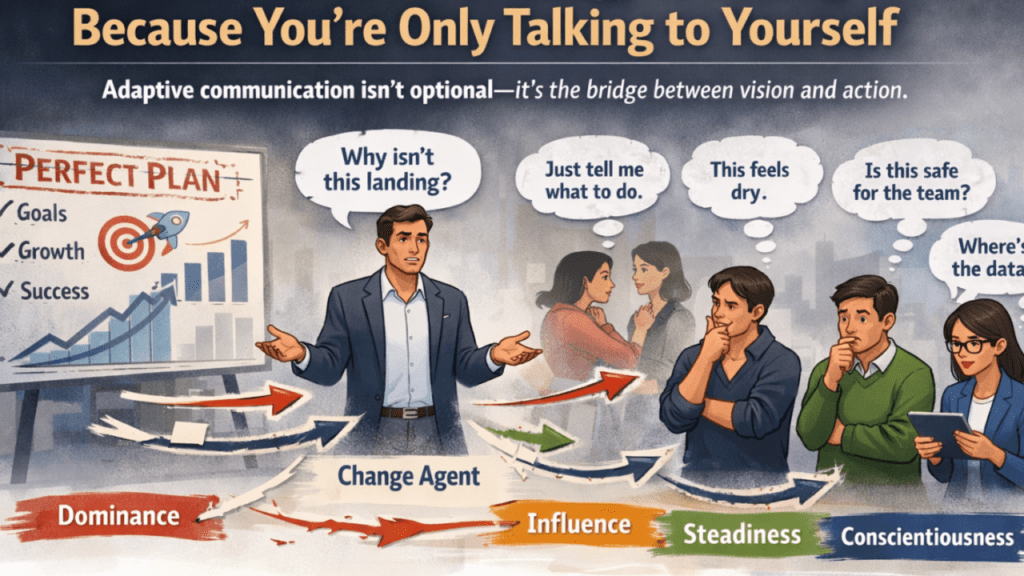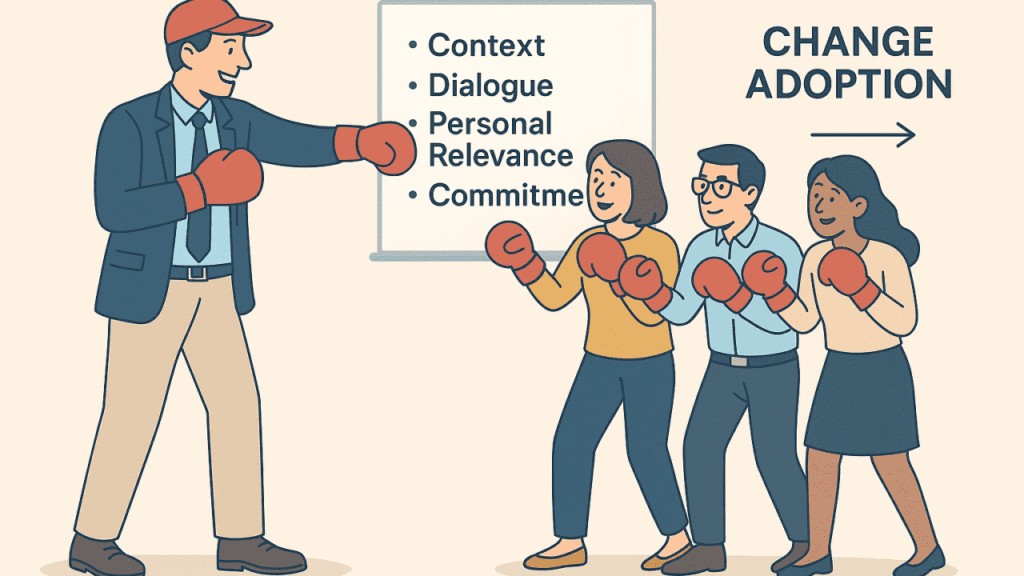
The real challenge in transformation isn’t getting people to nod in agreement, it’s converting that agreement into actual behavioral adoption
As change agents, we have all experienced this frustrating pattern: A transformation program officially launches. The communication decks are crystal clear. Governance is set. Yet, weeks later, momentum stalls. Meetings go suspiciously quiet. Teams appear compliant on the surface, but on the ground, operational behaviors remain exactly the same
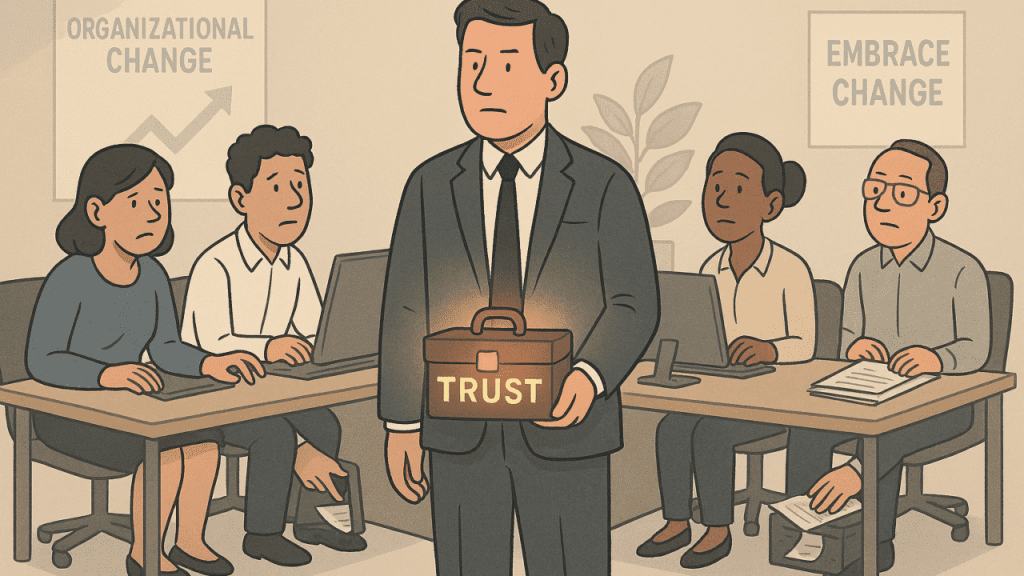
At this stage, most leaders assume this is a capability gap or a natural resistance to change. But in reality, what deteriorates first is trust.
During organizational transitions, uncertainty always outpaces clarity. When trust weakens, information is filtered, risks are hidden, and visible disagreement quietly shifts into silent non-adoption. For those of us operating between leadership expectations and operational realities, this becomes the hidden friction that kills transformation.
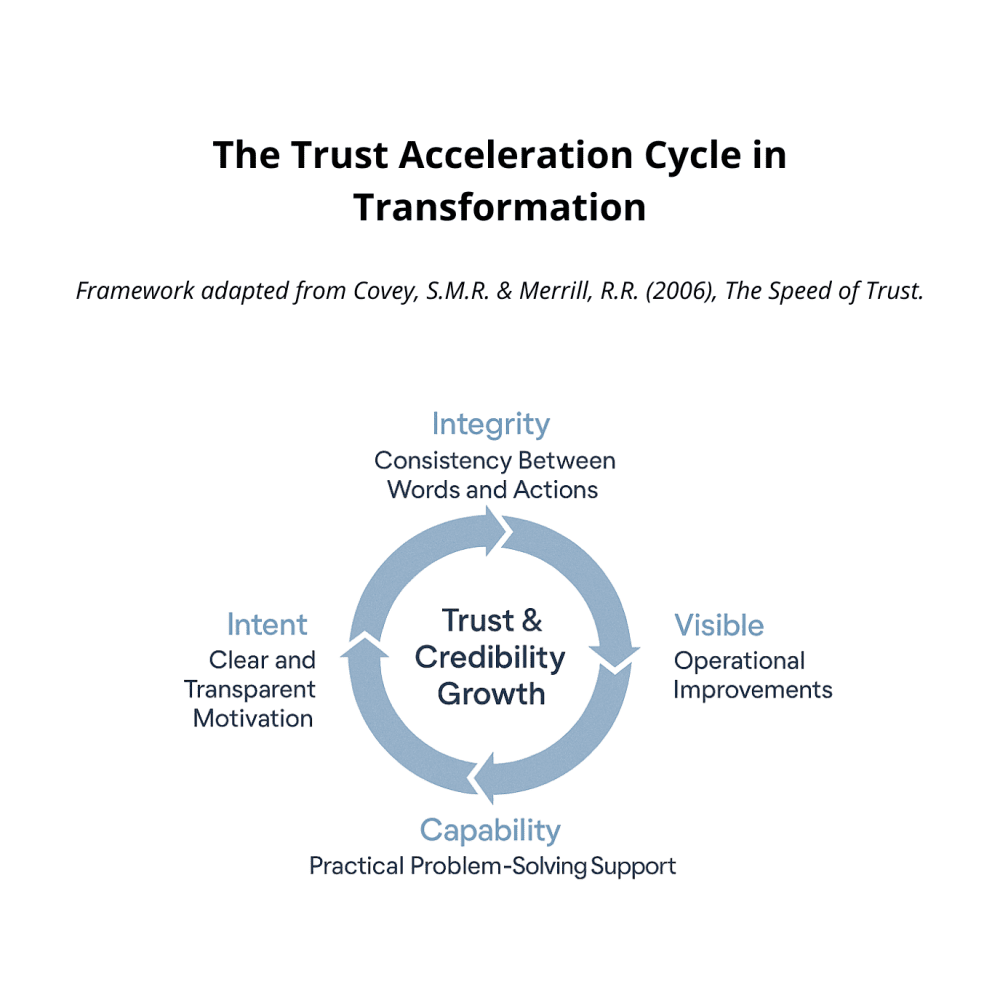
The good news? Trust isn’t just an abstract leadership trait. It’s a practical capability you can build through daily habits. Drawing on the core pillars of credibility based on Stephen Covey and Rebecca Merill, trust in the field relies on four observable foundations.
- Integrity: Do your words match your daily actions?
In transformation work, integrity is tested less by major decisions and more by small operational moments. Teams quickly notice inconsistencies such as:
- Commitments made that are never followed up.
- Escalations promised but not communicated back.
- Messages that change depending on the audience.
For change agents, integrity means operational congruence.
Practically, this involves:
- Closing feedback loops after discussions or diagnostics.
- Transparently acknowledging constraints instead of overpromising solutions.
- Admitting when assumptions or plans need adjustment.
When teams see consistency between what is said and what actually happens afterward, credibility begins to accumulate.
2. Intent: Answering “Why does this matter for me?”
Resistance frequently emerges not from disagreement with the transformation itself, but from uncertainty about intent. Frontline teams often interpret transformation initiatives through personal risk lenses:
- Will this reduce my role?
- Is performance monitoring increasing?
- Are decisions already predetermined?
If intent remains unclear, even technically correct recommendations may be perceived as enforcement rather than support. In practice, change agents must continuously translate organizational objectives into local relevance.
This includes:
- Explicitly explaining decision rationale rather than relying on formal announcements.
- Addressing trade-offs honestly.
- Framing change outcomes in terms of operational improvement, not corporate compliance.
Trust accelerates when teams perceive alignment rather than hidden agendas.
3. Capabilities: Proving you can actually solve problems.
Good intentions alone do not sustain credibility in high-pressure environments. Operational teams evaluate trust partly through competence signals: Can this person actually help us solve problems?
Change agents strengthen trust when they demonstrate tangible capabilities such as:
- Structured problem diagnosis.
- Understanding operational workflows.
- Translating abstract frameworks into workable actions.
Simple behaviors matter significantly:
- Helping clarify bottlenecks during implementation.
- Providing practical tools instead of additional reporting burdens.
- Supporting managers in navigating ambiguity.
Capability reassures teams that engagement with the change process creates real support rather than additional workload.
4. Results: Delivering visible proof.
Trust ultimately compounds through evidence. During transformation fatigue, teams rarely believe long-term promises. What rebuilds confidence are visible improvements experienced early in the process. Effective change agents therefore focus on creating small but credible proof points, such as:
- Reduced approval delays.
- Simplified coordination processes.
- Measurable efficiency improvements within pilot teams.
These early results function as behavioral signals: the new way is genuinely better than the old one. Without visible outcomes, skepticism naturally returns.
When credibility erodes during rollout phases, several patterns typically emerge:
- Information becomes selectively shared.
- Adoption reporting becomes overly optimistic.
- Informal workarounds reappear.
- Change agents lose influence despite formal authority.
Over time, this can lead to initiative fatigue, declining engagement, and ultimately the perception that transformation itself does not work.
Building Trust as a Daily Operational Practice
When trust is intentionally reinforced, something shifts in the field. Conversations become more candid, risks surface earlier, and adoption begins to move with less friction because teams can see the change working in their reality. For change agents working directly with teams, trust-building rarely requires large interventions. It is reinforced through repeated small actions. Three practical starting points include:
1. Maintain execution consistency: Document commitments and visibly follow through. Reliability compounds faster than persuasion.
2. Deliver early operational wins : Prioritize improvements that teams can immediately experience rather than waiting for large milestone achievements.
3. Invest time in listening before intervening : Understanding informal concerns often reveals adoption barriers that formal diagnostics miss.
Psychological safety doesn’t emerge from flashy communication campaigns. It develops when teams consistently experience fairness, competence, and reliability in action. Ultimately, teams don’t adopt change because they are told to, they adopt it because they see it working.
During periods of transition, trust isn’t defined by your intentions, but by what your teams repeatedly observe under pressure.
Over to you: Out of the four foundations—Integrity, Intent, Capabilities, and Results—which one do you find hardest to sustain in real-world rollouts? Let’s discuss in the comments below! 👇
#ChangeBEACON #Leadership #BuildingTrust #Impact #Transformation #StrategyExecution #Management
Reference: Covey, S. M. R., & Merrill, R. R. (2006). The speed of trust: The one thing that changes everything. New York: Free Press