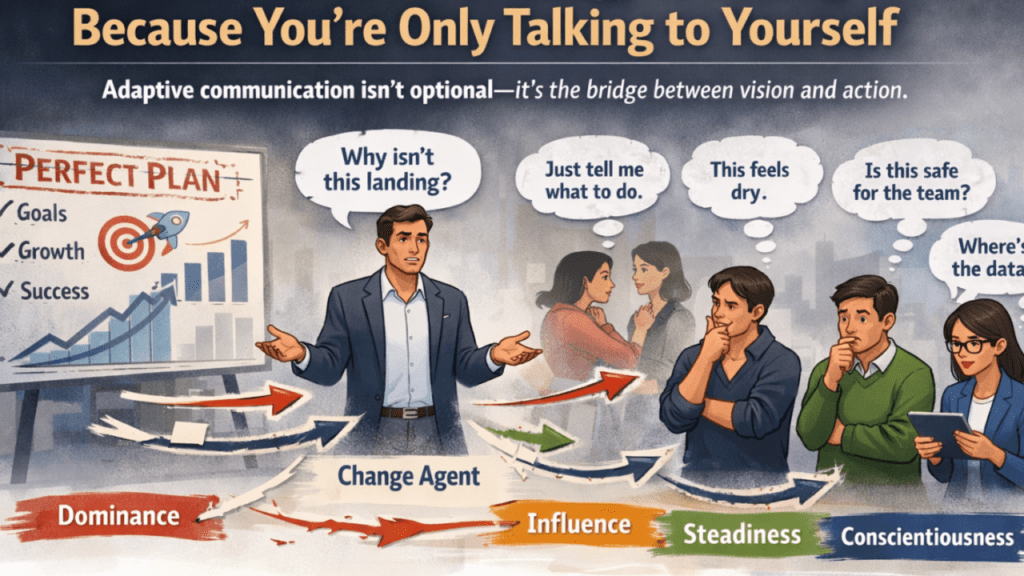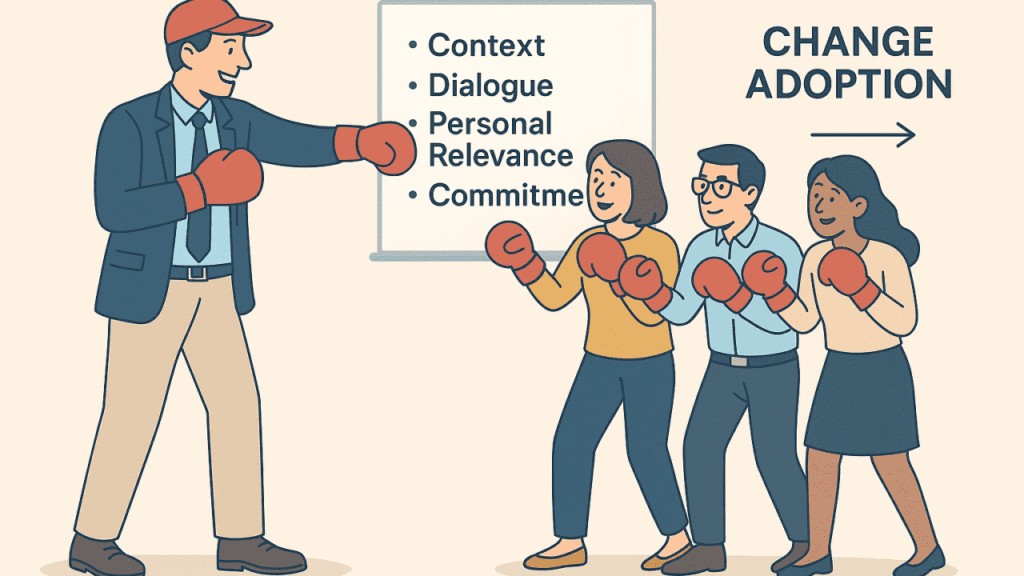

In the corporate world, we love to talk about “transformation.” We launch massive programs, overhaul systems, and restructure entire departments. We frame change as a monumental, strategic undertaking. But in doing so, we often make it feel heavy, intimidating, and disconnected from the people who have to live with it every day.
For the frontline employees—the ones in the operation—change isn’t a grand vision; it’s a daily, operational, and often perceived as an inconvenient reality. This is where the disconnect happens. Ambitious, enterprise-wide goals mean nothing if they don’t translate into small, tangible wins on the ground. This is where your Change Agents become your most valuable players.
While most Change Agents are trained on the grand strategy and the complex frameworks, many lack a simple, disciplined method for creating visible, peer-to-peer momentum. Yet, it’s a momentum that determines whether a change sticks or fades away. This is why a focus on short-term wins isn’t just a good idea; it’s a strategic necessity, a concept championed by John P. Kotter in his seminal work, Leading Change.
Here is a practical protocol your Change Agents can use to make it happen.
The 3-Step Small Wins Protocol
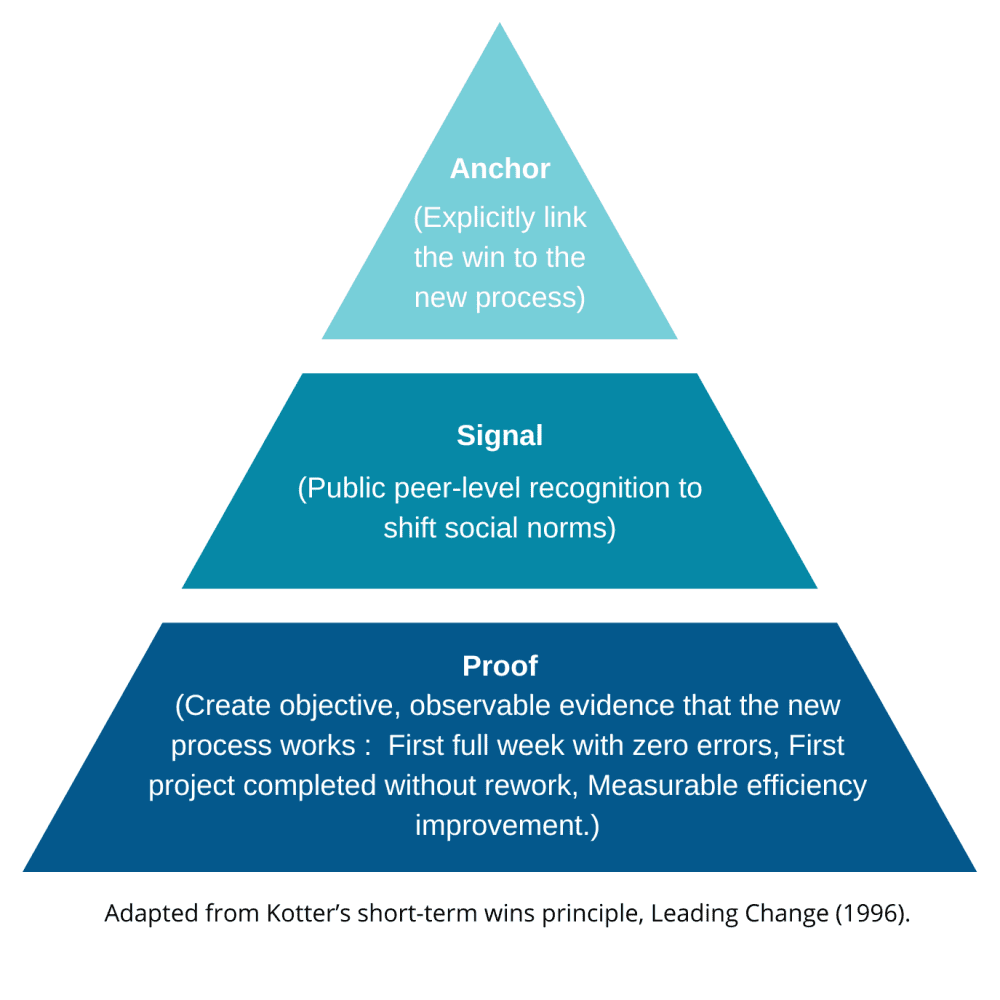
1. Engineer the Small Wins: Design a Concrete Proof Point
Meaningful wins are not happy accidents; they are intentionally engineered. The first job of a Change Agent is to identify a specific, observable milestone that provides undeniable proof that the new way is better than the old one. This milestone can’t be abstract; it must be concrete and irrefutable.
Examples of powerful first wins:
- “Our first full week with zero errors using the new system.”
- “The first project completed with the new template that required no rework.”
- “The first team meeting run entirely with the new process, finishing on time.”
The core principle here is to visibly validate the change. This is how you shift the narrative from “management claims this is better” to “we just proved this is better.”
2. Make It Social: Reinforce Success at the Peer Level
Recognition doesn’t have to come from the top down, and it doesn’t need to be monetary. For building early momentum, informal, peer-level acknowledgment is often far more potent.
A smart Change Agent will deliberately broadcast the win through channels that matter to the team:
- A celebratory shout-out in a team email.
- A “Win of the Week” flyer posted at a shared workstation.
- A quick, public acknowledgment during a daily team huddle.
Why does peer-level recognition work so well? Because culture spreads horizontally long before it moves vertically. When employees see their colleagues succeeding and being celebrated for using a new process, the psychological barrier to entry plummets. The change starts to feel normal, achievable, and socially accepted.
3. Anchor the “Why”: Connect the Win to the Change
Celebrating a victory is only half the battle. To make it stick, the Change Agent must connect the “what” to the “how.” Immediately after a milestone is hit, the Change Agent should pose a simple but powerful question to the team or individual: “How did this new process help you achieve this win?”
This question is a game-changer for two reasons:
- It forces an explicit acknowledgment of the benefit.
- It rewires the team’s thinking, attributing the success not just to individual heroics, but to the improved system itself.
Don’t Ignore the Small Slips: Integrating a Failure Protocol
Momentum is a fragile thing. When you see someone quietly reverting to an old spreadsheet or skipping a step in the new workflow, it’s not a minor compliance issue to be logged and forgotten. It’s an early warning signal that your change is at risk.
A disciplined Change Agent addresses these moments head-on with a Small Failure Check:
- Notice the slip immediately. Don’t let it slide.
- Address it privately and constructively. This isn’t about public shaming.
- Frame the conversation as coaching, not policing. The tone should be supportive.
- Reinforce the “why” behind the new process and its benefits.
The objective is simple: prevent micro-relapses from snowballing into a full-scale cultural rollback. In any change initiative, neglect and apathy compound just as powerfully as progress and enthusiasm.
Final Reflection
Change initiatives rarely fail because the strategy was wrong. They fail because momentum was never systematically built at the operational level where the work actually happens. Most change doesn’t die in a dramatic explosion; it fades into irrelevance in a quiet whisper of indifference.
This often happens for one simple reason: no one took the time to engineer the early wins.
What was the first small, visible win that made you finally believe in a change?
Let’s discuss on the comment section.
#ChangeBEACON #Leadership #SmallWinsProtocol #Transformation #StrategyExecution #Management
Reference: Kotter, J. P. (1996). Leading Change. Harvard Business School Press