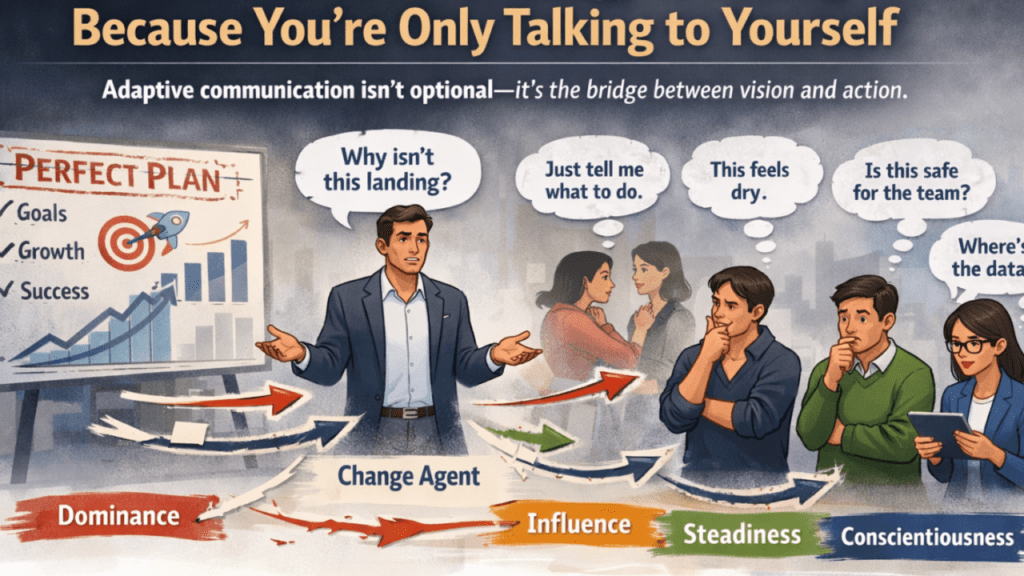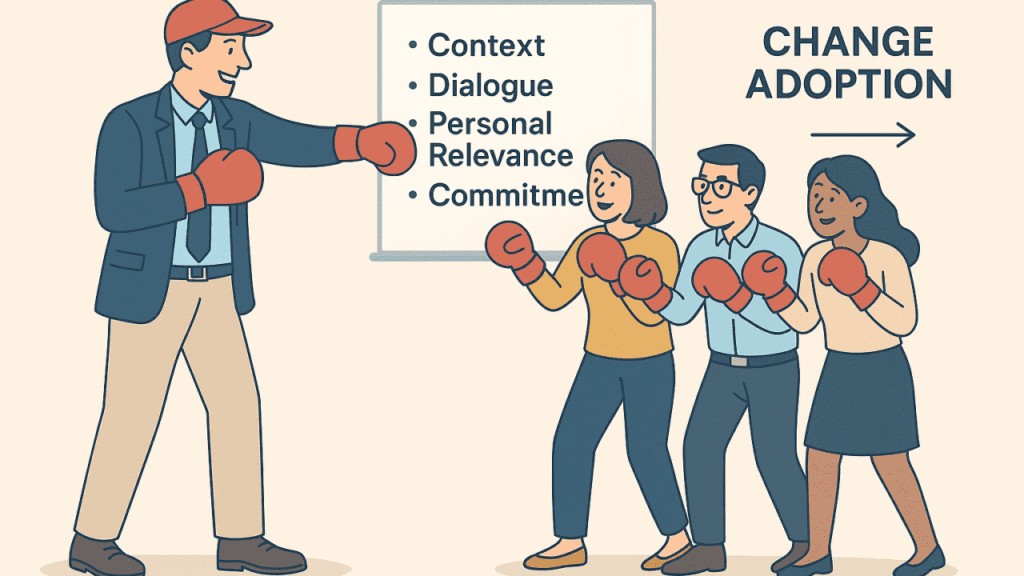
Corporate transformations are designed in the boardroom, but they are won or lost in the trenches. Executives invest heavily in strategy, technology, and operating model design. Yet a global analysis by Boston Consulting Group (BCG) delivers a sobering verdict: only one in four organizational change initiatives succeeds in delivering enduring, value-creating change.
The gap between strategy and execution is rarely a planning failure. It is almost always a people failure, and more specifically, a failure to understand what is actually driving behavior beneath the surface.
For change agents, this is the real battlefield. Not the slide deck. Not the project timeline. The weekly team huddle, the training workshop, the hallway conversation where a peer quietly admits they have no idea what the new system is actually for.
As practitioners closest to the human side of change, the most powerful tool in a change agent’s arsenal is not a better framework — it is a deeper understanding of human psychology. Patrick King, in his book Read People Like a Book, offers exactly that lens: a way to move beyond what people say and into what is actually shaping their resistance.
The Biological Math of Resistance
When presenting a new system or process to peers, the instinct is to lead with logic: here are the benefits, here is the data, here is why this makes sense. The assumption is that rational arguments drive rational behavior. They rarely do.
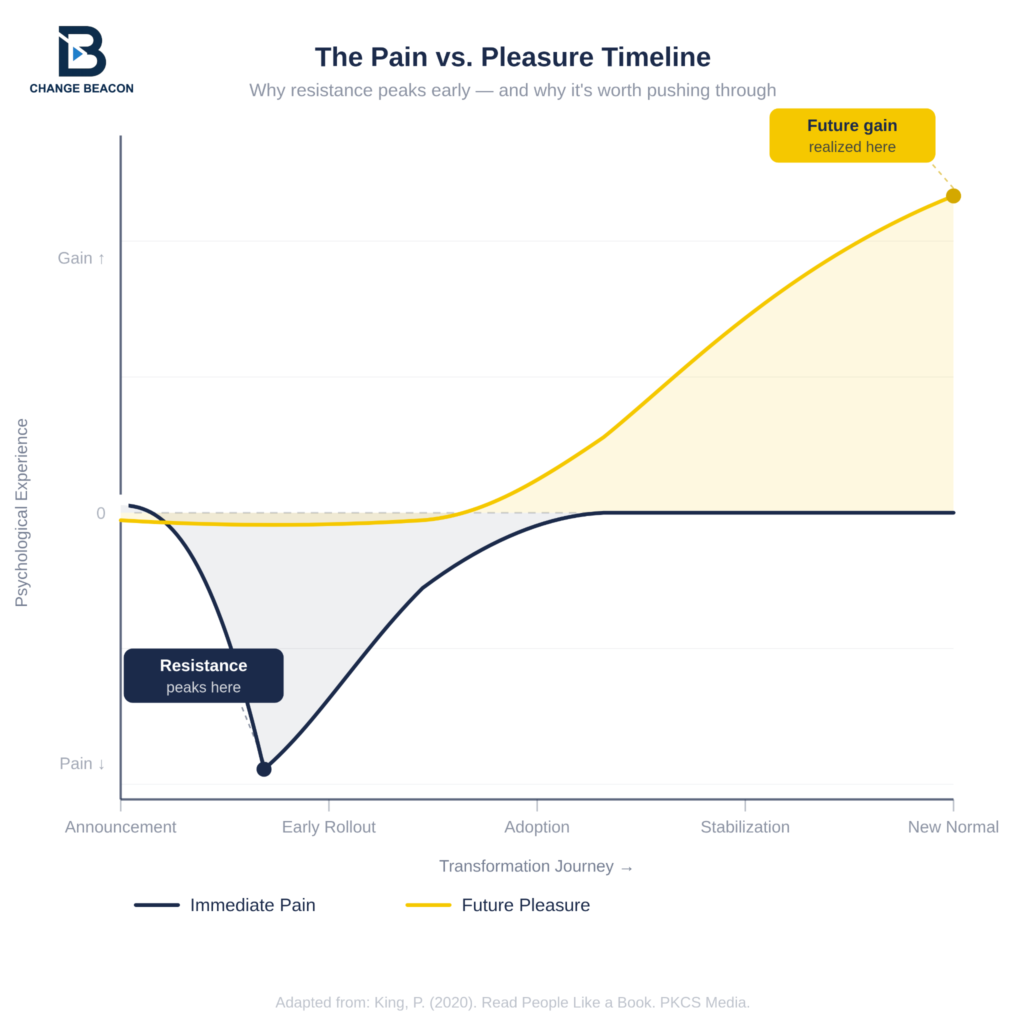
King’s framework highlights that human behavior is fundamentally governed by the pleasure-pain principle and critically, the brain is wired to work far harder to avoid pain than to pursue gain.
In the context of organizational change management, the promise of a streamlined future is abstract and distant. What peers perceive immediately and viscerally is the pain of transition: the discomfort of not knowing, the exhaustion of relearning, the quiet fear of becoming obsolete.
When a colleague resists adopting a new platform, they are rarely being obstructive. More often, their brain is running a straightforward calculation, and the immediate cost of change is outweighing the distant benefit. Survival instincts do not respond to quarterly targets. Effective change agents stop selling the destination and start directly acknowledging the difficulty of the journey.
Unmasking the Resistance
Every change initiative surfaces its cynics, such as the peer who dismisses the initiative in every meeting, the colleague who hasn’t logged into the new platform weeks after go-live. The default response is frustration. The more productive response is curiosity.
King explains that the behaviors we find most difficult in others often mask something far more vulnerable underneath. The colleague who aggressively dismisses a new process as “unnecessary” is frequently not expressing confidence, they are protecting it. Beneath the cynicism is often a seasoned professional quietly terrified of losing the expertise that has defined their professional identity for years.
The ego, unwilling to sit with that vulnerability, deploys its defenses automatically. Rationalization — attributing non-adoption to poor training materials rather than personal discomfort. Denial — insisting the old way works perfectly well when the evidence says otherwise.
Recognizing these not as acts of sabotage, but as subconscious shields protecting fragile self-worth, fundamentally changes how a change agent intervenes. The response shifts from pressure to psychological safety, from pushing harder to creating the conditions where peers feel secure enough to try, stumble, and try again.
What the Body Says Before the Words Do
Buy-in conversations tend to be heavily verbal. But King’s framework is clear: people communicate their true anxieties far more through behavior than through words because the body cannot help but respond to perceived threat.
In any training or alignment session, the signals worth reading are not on the agenda, they are in the room. Pacifying behaviors: neck-rubbing, hand-wringing, closed posture, torsos angled toward the exit, those are the body’s honest report on how a person is actually processing what they are hearing. These are not random habits; they are unconscious self-soothing gestures triggered when someone feels stressed or cornered.
Pushing harder with deadlines and data when these signals are present does not accelerate adoption. It deepens resistance. A skilled change agent reads the room before reading the roadmap: pausing, naming the unspoken tension, and creating space for peers to voice what they have not yet felt safe enough to say. That pause, more often than not, is what unlocks genuine movement.
Where Psychology Meets Practice: The BEACON Framework
Understanding human psychology is only half the equation. The other half is knowing what to do with that understanding in practice.
This is where structured change agent practice becomes essential. The BEACON Role Framework — Bridge, Educate, Advocate, Communicate, Observe & Overcome, Nurture — provides change agents with a clear, interconnected set of responsibilities designed to translate psychological insight into deliberate action throughout the change lifecycle.
The Observe & Overcome role, in particular, operationalizes much of what King’s framework describes: rather than relying on surface-level observation, the change agent actively steps into the perspective of impacted individuals, empathically diagnosing the emotional, practical, and systemic realities driving their resistance. Similarly, Nurture ensures that adoption doesn’t fade after go-live, sustaining momentum precisely through the periods when psychological fatigue is highest.
Together, BEACON ensures that the human depth required to navigate resistance isn’t left to instinct — it is structured, practiced, and consistently applied.
Reflection
Organizational change management ultimately succeeds not when the system goes live, but when the people running it feel genuinely understood, not merely managed through a process. The psychological dimension of change is not a soft footnote to execution. It is the execution.
At Change Beacon, this is precisely the practitioner perspective we are built around equipping change agents not just with tools and methodologies, but with the human depth to navigate resistance, build trust, and make change actually stick from the inside out.
What forms of peer resistance have you encountered in your change management work and what helped you move through it? Share your experience in the comments.
#ChangeBeacon #ChangeManagement #ChangeAgent #OrganizationalChangeManagement #PeerResistance #HumanBehavior #PsychologyAtWork #ChangeLeadership #AdoptionStrategy #ResistanceManagement #PeopleFirst #BehavioralChange #ChangeAgentLife #BEACONFramework #PractitionerInsights
References:
- King, P. (2020). Read people like a book: How to analyze, understand, and predict people’s emotions, thoughts, intentions, and behaviors. Patrick King.
- Reeves, M., Gruß, C., Ellmer, K., Job, A., Bouslov, G., & Catchlove, P. (2024, June 21). How CEOs can beat the transformation odds. Boston Consulting Group.
- Change Beacon. (2026). Change Agent Practice Guide (CAPG) (1st ed.). Change Beacon